
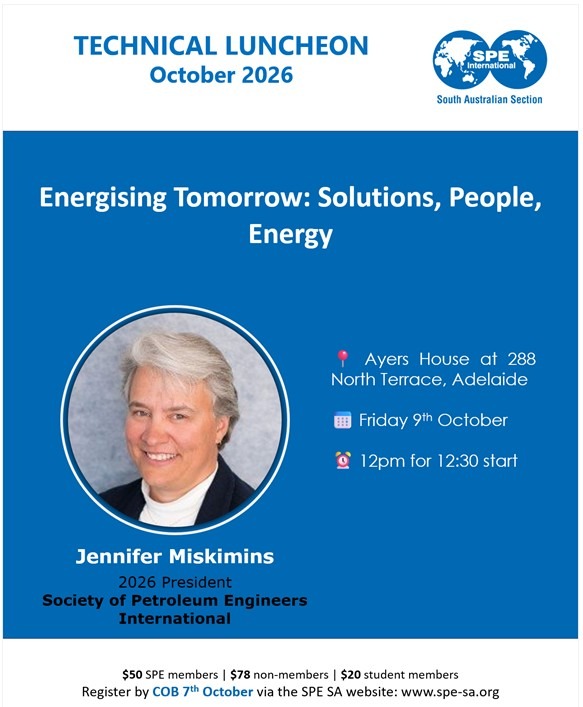
SPE Technical Luncheon October 9th 2026
Location
Ayers House
About
Title: Energising Tomorrow: Solutions, People, Energy
Abstract:
The Society of Petroleum Engineers (SPE) has its roots as the petroleum committee of the American Institute of Mining Engineers (AIME) initiated in 1913. In 1957, SPE was founded as a constituent society of AIME, and in 1985, SPE became a separate incorporated organization. Today SPE is a global organization that stands at over 125,000 members worldwide, with operations in 146 countries with over 200 professional sections and over 400 student chapters worldwide.
SPE’s core mission has always been focused on technology transfer and facilitating the technical and professional competence of our members. However, over time, SPE has grown and changed to align with what its members need and desire. While we are still oil and natural gas at our core, we have expanded to offer programs and technology transfer opportunities in CCS, CCUS, hydrogen, subsurface storage, emissions reduction, critical minerals, and geothermal. These core, low carbon, and new energies areas align with what our members want and need, helping to supply the world’s energy needs.
This presentation will present an overview of the current status of SPE and where the society is headed in the future. Special initiatives focused on geothermal, AI, and other topical areas will be discussed, and an update on the 2026-2027 Strategic Plan planning will also be provided.
Bio:
Jennifer L. Miskimins is a professor and the department head of the petroleum engineering department at the Colorado School of Mines (Mines), where she holds the F.H. Mick Merelli/Coterra Energy Distinguished Department Head Chair.
She has over 30 years of experience in the petroleum industry, starting with Marathon Oil Company as a production engineer. Miskimins began teaching at Mines in 2002 and has held various appointments since then. From 2013–2015, she held a part-time appointment at Mines while working at Barree & Associates. In 2016, she returned full-time to the university.
Miskimins served as the first Completions Technical Director on the SPE International Board of Directors. She was an SPE Distinguished Lecturer in 2010–2011 and 2013–2014. She was awarded the 2014 SPE Completions Optimization and Technology Award, and in 2022, she received the SPE Distinguished Achievement Award for Petroleum Engineering Faculty.
Miskimins has served on a variety of conference organizing committees, including chairing the 2023 and 2024 SPE Hydraulic Fracturing Conference and Exhibition, and as a technical editor for SPE journals, including serving as the executive editor of Production & Operations for 3 years. She was the editor in chief for the 2019 SPE Monograph update “Hydraulic Fracturing: Fundamentals and Advancements.” Miskimins has served on the AIME Board of Trustees since 2018 as an SPE trustee and was the 2022 AIME president.
Miskimins holds a BS from the Montana College of Mineral Science and Technology and MS and PhD degrees from the Colorado School of Mines, all in petroleum engineering.