
Reading Fluency: What works and why?
Location
About
Reading Fluency. What works and why?
The Science of Teaching and Learning Australia (SOTLA), Sharing Best Practice (SBP), and the Fitzroy Valley Schools Network bring to the Kimberley a leading international and national expert with an accomplished classroom practitioner to equip educators with the knowledge, tools, and practical strategies to develop confident, competent, fluent readers.
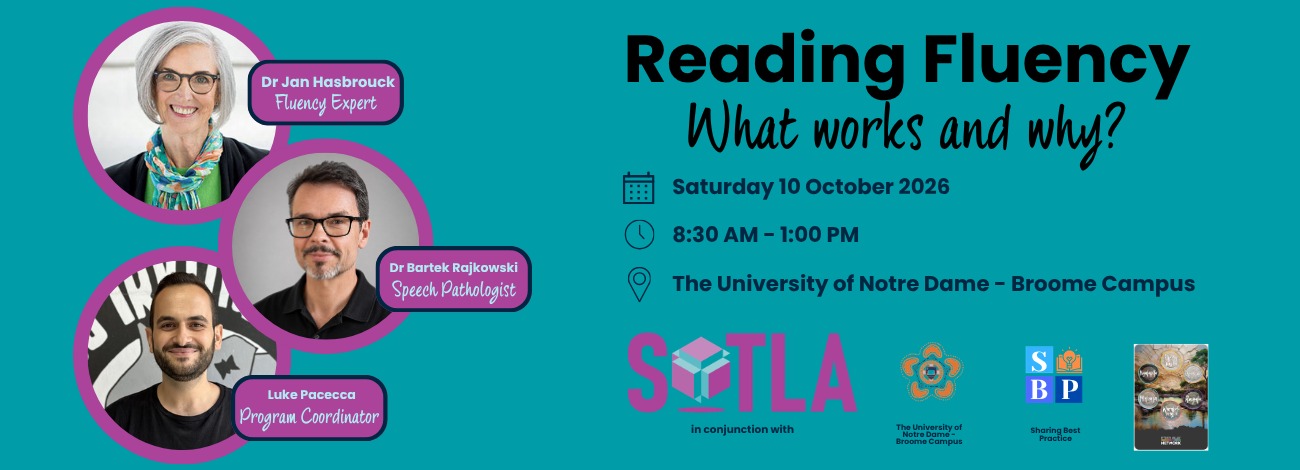
Dr Jan Hasbrouck. Fluency: It's All About Comprehension
Helping students read fluently is a focus of the efforts of many teachers and specialists. And that's a good thing, because research has clearly identified that fluency is “a critical component of skilled reading” (NRP, 2000) and fluency standards have also been included as a sub-element of the reading in the National Literacy Learning Progression as well as the International Dyslexia Association’s Knowledge and Practice Standards for Teachers of Reading. But...do we really understand what fluency is? Do we understand how to determine which students are sufficiently fluent and which need more help? And what kind of support do our students need to become fluent? Let's revisit this topic with an emphasis on the purpose of fluent reading: Comprehension!
Dr Bartek Rajkowski. The Sounds Behind the Words: What Teachers Need to Know to Teach Reading and Spelling
Successful reading and spelling depend on children understanding how the sounds of spoken English are represented in print. This session explores the structure of the English writing system and the critical roles of phonemic awareness, grapheme knowledge, decoding, encoding and orthographic mapping in literacy development. Participants will examine why some students struggle to crack the alphabetic code and how a strong understanding of the links between English phonology and orthography can help teachers provide clearer, more explicit and effective reading and spelling instruction. The session provides a foundation for understanding how accurate word recognition develops, complementing Jan Hasbrouck’s focus on the development of fluent reading.
Luke Pacecca - Providing the Targeted Practice Students Need: How an Online Program Supports Fluency
This session offers a practical look at how targeted, individualised practice can be delivered at scale, through the case of one remote community school's trial of an online fluency program (Reading Doctor) alongside core literacy programs. Luke will briefly set the scene: termly data dialogues confronting stalled reading progress, and the challenge of delivering enough of the right practice amid variable attendance, engagement, and ability levels. The session then turns to how Reading Doctor has supported this work in practice: why it was chosen, how it has been implemented alongside core programs, how students have responded, and what the data is showing.
CATERING
Morning tea will be provided.