
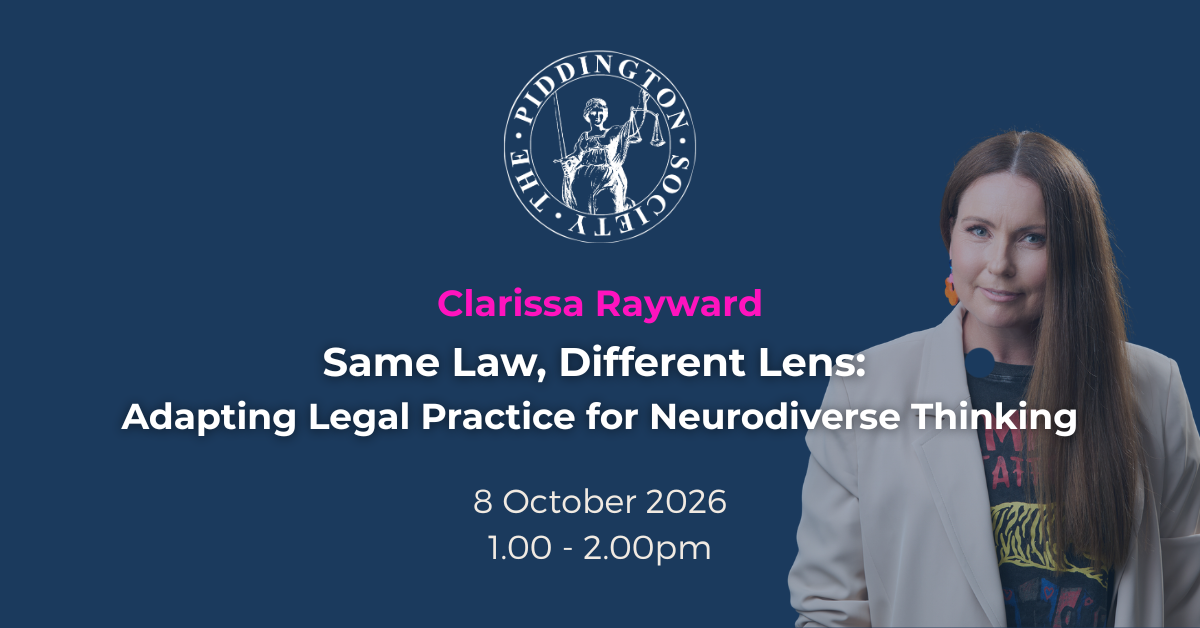
Same Law, Different Lens: Adapting Legal Practice for Neurodiverse Thinking
TIME: 1:00pm WA time
FORMAT: Zoom
Join us online on the 8th of October at 1 pm with Clarissa Rayward to explore the topic of same law, different lens.
The law might be the same for everyone, but the way our clients process, understand and experience it certainly isn't. In this practical 90-minute workshop, Clarissa Rayward draws on her years working directly with family law clients to explore how neurodivergence can influence communication, information processing, decision-making and a client's ability to participate effectively in the legal process.
She will also share what she's observed, in practice, about how these dynamics can intensify when clients are also navigating trauma and the stress and uncertainty of legal disputes - not as a clincal frameowrk, but as a practical, on the ground insights for lawyers.
Rather than focusing on diagnosis or labels, this session is about what lawyers can actually do differently — with simple, practical adjustments to the way we communicate, meet with, advise and support our clients. Because sometimes what looks like a difficult or disengaged client may simply be a client experiencing the process differently.
Speaker:
Clarissa Rayward is a wife, mum to two, accredited specialist family lawyer, and lover of chocolate, coffee, and anything colourful. When she’s not writing, dancing, or “bedazzling” in her craft projects, Clarissa is the Director of Brisbane Family Law Centre, a multidisciplinary practice where lawyers work alongside counsellors and financial experts to provide holistic support to clients navigating divorce and separation.
In 2015, Clarissa published her first book, Splitsville – How to separate, stay out of court and stay friends, and since then has trained family lawyers across Australia and internationally in better, kinder ways to help clients through divorce.
Alongside her legal practice, Clarissa is the founder of Happy Lawyer Happy Life, a business dedicated to supporting lawyers to build legal practices that place happiness and wellbeing at their core. Her work in this space has seen her recognised nationally, including as the 2019 Lawyers Weekly Australian Law Awards Wellness Advocate of the Year, the inaugural Minds Count Individual Wellness Advocate in Law, and the 2022 recipient of the Qld Law Society Agnes McWhinney Award, honouring women lawyers who forge new pathways in law and the community.
Today, Clarissa continues to work with families across Australia while also advocating for a healthier, more sustainable legal profession. Her mission is to reshape the way law is practised—reducing the profession’s high rates of anxiety, depression, and psychological distress—perhaps paving the way for her daughters, should they one day choose to follow in her footsteps.
This event will be conducted online, via Zoom. A link will be provided on the morning of the session.
Cancellations:
For cancellation and refund details, please see our Cancellation and Refund Policy.
Notes:
Practitioner ID numbers are issued by the Legal Practice Board of Western Australia. Information from the Board is available here. We require these to issue CPD certificates. If you do not want a CPD certificate, please put '0000' in the box on the booking form.
Like all Piddington events, your attendance, engagement and support goes toward supporting funding Piddington's access to justice projects. These are: the Piddington PLT Fund, which supports the community legal centres (CLCs) that host Piddington PLT graduates to complete their hours required for admission; the Piddington Justice Fund for CLCs, to cover costs that they otherwise cannot meet; and, Kaartdijin, our First Nations Legal Education Fund. We also fund the Christine Wheeler PLT Scholarship and John Chaney Award for new law graduates and law students.
This program is delivered by The Piddington Society, an accredited CPD Provider approved by the Legal Practice Board of Western Australia. CPD schemes in other Australian jurisdictions do not accredit or pre-approve providers or courses. As a result, practitioners outside Western Australia must self-assess this activity against the CPD rules in their home jurisdiction and determine whether it meets their professional development obligations. Certificates of completion are issued to assist with record-keeping, but the final decision as to compliance rests with the individual practitioner and their local regulator. Participants should also note that some jurisdictions impose caps on certain delivery modes (e.g. South Australia limits 5 units per CPD year for web-based/recorded programs).
Date
Thursday 8 October 2026 1:00 PM - 2:30 PM (UTC+08)Location
Online event access details will be provided by the event organiser

Contact Form

Resend recently purchased tickets to our events to your email.
Enter email to start search
You can review the event organiser's terms and conditions here.