
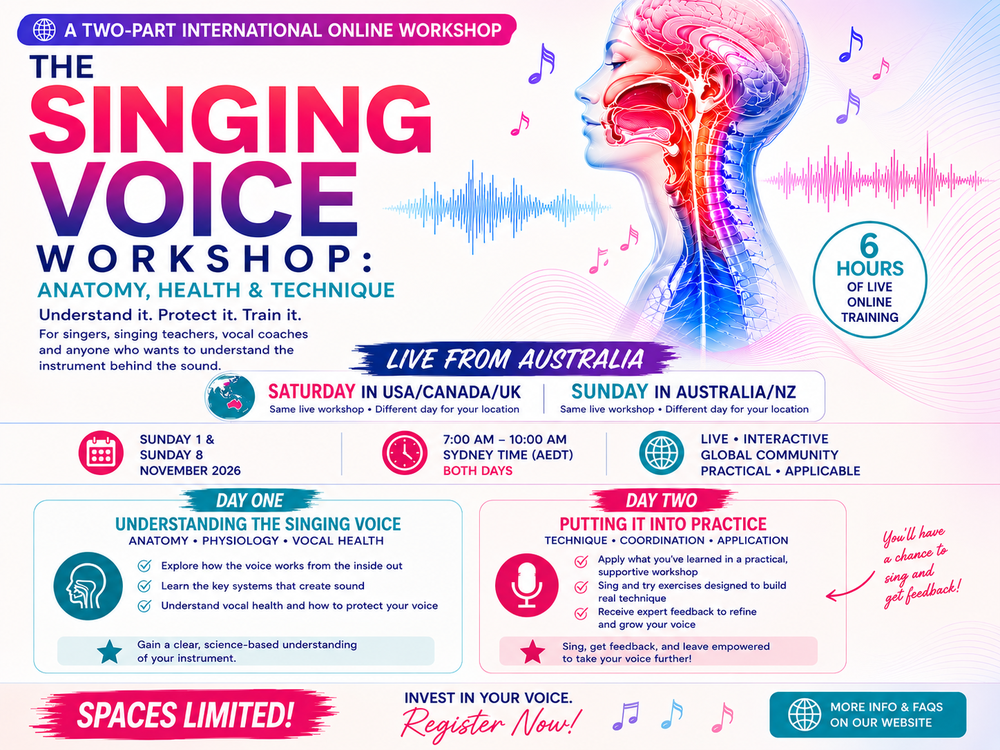
The Singing Voice Workshop: Anatomy, Health & Technique
Location
Online event access details will be provided by the event organiser
About
The Singing Voice Workshop: Anatomy, Health & Technique
A Two-Part International Online Workshop
Sunday 1 & Sunday 8 November 2026
7:00 AM – 10:00 AM Sydney Time (AEDT)
6 Hours of Live Online Training
Whether you're a singing teacher wanting to deepen your understanding of the instrument you teach, or a singer wanting to better understand the voice you use every day, The Singing Voice Workshop: Anatomy, Health & Technique is designed to bridge the gap between understanding the voice and actually using it.
Across two live, three-hour online workshops, we'll explore the anatomy and function of the singing voice, the principles of vocal health, and how this knowledge translates into practical singing technique.
Rather than simply learning what exercise to use, we'll look at why it works, what is happening physiologically, and how different parts of the vocal system work together to create sound.
Led by Tina Alcorace, founder of Rise Academy of Music and vocal coach with over 15 years of teaching experience, this workshop brings together anatomy, vocal health, technique and practical application in an accessible environment designed for singers and singing teachers around the world.
DAY ONE — UNDERSTANDING THE SINGING VOICE
Anatomy • Physiology • Vocal Health
Sunday 1 November | 7:00–10:00 AM AEDT
Day One takes you inside the singing voice.
We'll break down the major structures involved in singing and explore how they work together as one coordinated system.
You'll develop a clearer understanding of what is physically happening when you breathe, phonate, change pitch, alter resonance and produce different vocal qualities.
We will explore:
The respiratory system
Understand the role of the lungs, diaphragm, rib cage and surrounding musculature in singing, and how airflow and pressure contribute to efficient voice production.
We'll also unpack some of the common misconceptions surrounding "breath support" and look at what singers are actually coordinating when managing breath.
The larynx and vocal folds
We'll explore the anatomy of the larynx, including the vocal folds and the structures responsible for controlling pitch and vocal fold behaviour.
You'll learn how sound begins at the level of the vocal folds and what changes when we move through different pitches, volumes and vocal qualities.
The muscles involved in singing
We'll look at key intrinsic and extrinsic muscles involved in voice production and discuss their roles in pitch, registration, stability and vocal function.
The aim isn't to simply memorise anatomical terminology — it's to understand why the anatomy matters when you're actually singing or teaching someone to sing.
Resonance and the vocal tract
We'll explore what happens to the sound after it leaves the vocal folds and how the throat, mouth, tongue, jaw, soft palate and other structures influence the sound we ultimately hear.
We'll also discuss concepts such as nasality, resonance and vocal tract shaping.
Registers and vocal function
What are chest voice, head voice, mix and falsetto?
We'll begin separating traditional singing terminology from what is actually happening physiologically and acoustically, helping you build a clearer understanding of vocal registration.
VOCAL HEALTH
A significant part of Day One will focus on caring for the instrument.
We'll explore what healthy voice use actually looks and feels like, along with factors that can influence vocal function and recovery.
Topics will include:
Vocal load and fatigue
Hydration and the voice
Warming up and cooling down
Vocal recovery
Recognising changes in your normal voice
Hoarseness and vocal fatigue
Speaking voice versus singing load
Environmental and lifestyle factors affecting the voice
Common vocal-health myths
When a vocal issue is outside the scope of a singing teacher
When referral to an ENT, laryngologist or speech pathologist may be appropriate
For teachers in particular, we'll discuss the importance of understanding the boundary between voice teaching and voice healthcare, and how to recognise when a student may need assessment from an appropriate healthcare professional.
By the end of Day One, you'll have a much clearer picture of the singing voice as an instrument made up of interconnected systems, rather than a collection of isolated techniques.
DAY TWO — PUTTING IT INTO PRACTICE
Technique • Coordination • Application
Sunday 8 November | 7:00–10:00 AM AEDT
Day Two takes everything we've learned about the instrument and asks the most important question:
How do we actually apply it to singing?
This session becomes much more practical and interactive as we explore how anatomical knowledge can inform exercises, technique, troubleshooting and vocal development.
Rather than approaching vocal exercises as random sounds or scales, we'll look at what we're trying to influence and why.
We'll explore:
Building an effective vocal warm-up
What should a warm-up actually accomplish?
We'll look at how to structure a warm-up progressively and how exercises can be selected according to the needs of the individual voice.
Breath and vocal coordination
We'll take the respiratory concepts from Day One and apply them practically to singing.
We'll explore the relationship between airflow, pressure, vocal fold behaviour and sound — and why simply telling a singer to "use more support" doesn't always solve the problem.
Understanding vocal registers
We'll practically explore chest voice, head voice and the coordinations commonly described as mix.
We'll discuss what singers may experience as they move through their range and why certain areas of the voice can feel more challenging.
Resonance and vocal tract shaping
We'll experiment with how changes to the tongue, jaw, lips, soft palate and vocal tract can influence the resulting sound and sensation.
This will help connect the anatomy you learned in Day One with sounds you can actually hear and feel.
Nasality and different vocal qualities
We'll explore the difference between nasal resonance, nasality and other qualities that singers and teachers commonly describe using subjective terminology.
Technique and troubleshooting
We'll look at common challenges singers encounter and explore how understanding the underlying function can help us make more informed choices.
Instead of immediately asking:
"Which exercise fixes this?"
we'll start asking:
"What might the voice be doing — and what are we trying to change?"
That shift is particularly valuable for teachers because it encourages critical thinking rather than one-size-fits-all exercises.
LIVE PRACTICAL WORKSHOP
Day Two will also include an interactive workshop component.
We'll put concepts into practice through vocal exercises, demonstrations and live discussion.
Participants will be encouraged to sing along, experiment with different coordinations and notice how changes in technique affect their own voice.
There will also be opportunities throughout the workshop to ask questions and explore concepts in real time.
This isn't designed to be six hours of sitting silently watching a presentation.
Come prepared to listen, learn, ask questions, make sound, experiment and participate.
WHO IS THIS WORKSHOP FOR?
This workshop has been designed for:
Singing teachers and vocal coaches who want to strengthen their understanding of vocal anatomy, health and function and bring greater reasoning into their teaching.
Emerging singing teachers who want to build a stronger foundation before or during their teaching journey.
Professional and developing singers who want to understand their instrument beyond simply being told what to do.
Music educators and performing arts teachers who regularly work with singers and want a better understanding of healthy vocal function.
And anyone with a genuine interest in understanding how the singing voice works.
You do not need a background in anatomy or voice science to participate.
Complex concepts will be broken down into practical, understandable language and continually connected back to singing.
WHAT YOU'LL WALK AWAY WITH
By the end of the two-part workshop, our goal is for you to have a clearer understanding of:
How the singing voice produces sound
The anatomy involved in breathing, phonation and resonance
How the vocal folds contribute to pitch and vocal quality
How the vocal tract influences the sound we hear
The relationship between anatomy and singing technique
Principles of healthy voice use and vocal recovery
How to recognise potential signs of vocal fatigue or difficulty
How anatomy can inform the selection of vocal exercises
How to think more critically when troubleshooting a voice
How to apply these concepts to your own singing or teaching
Most importantly, you'll leave with a better understanding of why.
Why does this exercise work?
Why does changing this sound affect the voice?
Why might a singer be struggling with a particular coordination?
Why does the voice respond differently from one person to another?
Because when we understand the instrument we're working with, we can make more informed decisions about how we train it.
YOUR REGISTRATION INCLUDES
6 hours of live online training across two three-hour workshops.
Part One: Anatomy, Physiology & Vocal Health
Part Two: Technique, Coordination & Practical Application
Plus:
Live demonstrations
Interactive vocal exercises
Participant Q&A
Downloadable workshop resources
Vocal anatomy reference materials
Practical exercises to continue exploring after the workshop
Workshop replay access
Certificate of completion
Investment
Early Bird — $150 AUD PER DAY
Standard Registration — $175 AUD PER DAY
Places are available internationally. Links will be sent prior to your event day.
THIS ISN'T ABOUT LEARNING MORE VOCAL "TRICKS."
It's about developing a deeper understanding of the instrument behind them.
Whether you're responsible for developing other people's voices or simply want to understand your own, The Singing Voice Workshop is an opportunity to step beneath the terminology and explore the anatomy, health and technique behind the singing voice.
Understand the instrument. Protect the instrument. Learn how to train it.
A Two-Part International Online Workshop
Sunday 1 & Sunday 8 November 2026
7:00 AM – 10:00 AM Sydney Time (AEDT)
6 Hours of Live Online Training
Whether you're a singing teacher wanting to deepen your understanding of the instrument you teach, or a singer wanting to better understand the voice you use every day, The Singing Voice Workshop: Anatomy, Health & Technique is designed to bridge the gap between understanding the voice and actually using it.
Across two live, three-hour online workshops, we'll explore the anatomy and function of the singing voice, the principles of vocal health, and how this knowledge translates into practical singing technique.
Rather than simply learning what exercise to use, we'll look at why it works, what is happening physiologically, and how different parts of the vocal system work together to create sound.
Led by Tina Alcorace, founder of Rise Academy of Music and vocal coach with over 15 years of teaching experience, this workshop brings together anatomy, vocal health, technique and practical application in an accessible environment designed for singers and singing teachers around the world.
DAY ONE — UNDERSTANDING THE SINGING VOICE
Anatomy • Physiology • Vocal Health
Sunday 1 November | 7:00–10:00 AM AEDT
Day One takes you inside the singing voice.
We'll break down the major structures involved in singing and explore how they work together as one coordinated system.
You'll develop a clearer understanding of what is physically happening when you breathe, phonate, change pitch, alter resonance and produce different vocal qualities.
We will explore:
The respiratory system
Understand the role of the lungs, diaphragm, rib cage and surrounding musculature in singing, and how airflow and pressure contribute to efficient voice production.
We'll also unpack some of the common misconceptions surrounding "breath support" and look at what singers are actually coordinating when managing breath.
The larynx and vocal folds
We'll explore the anatomy of the larynx, including the vocal folds and the structures responsible for controlling pitch and vocal fold behaviour.
You'll learn how sound begins at the level of the vocal folds and what changes when we move through different pitches, volumes and vocal qualities.
The muscles involved in singing
We'll look at key intrinsic and extrinsic muscles involved in voice production and discuss their roles in pitch, registration, stability and vocal function.
The aim isn't to simply memorise anatomical terminology — it's to understand why the anatomy matters when you're actually singing or teaching someone to sing.
Resonance and the vocal tract
We'll explore what happens to the sound after it leaves the vocal folds and how the throat, mouth, tongue, jaw, soft palate and other structures influence the sound we ultimately hear.
We'll also discuss concepts such as nasality, resonance and vocal tract shaping.
Registers and vocal function
What are chest voice, head voice, mix and falsetto?
We'll begin separating traditional singing terminology from what is actually happening physiologically and acoustically, helping you build a clearer understanding of vocal registration.
VOCAL HEALTH
A significant part of Day One will focus on caring for the instrument.
We'll explore what healthy voice use actually looks and feels like, along with factors that can influence vocal function and recovery.
Topics will include:
Vocal load and fatigue
Hydration and the voice
Warming up and cooling down
Vocal recovery
Recognising changes in your normal voice
Hoarseness and vocal fatigue
Speaking voice versus singing load
Environmental and lifestyle factors affecting the voice
Common vocal-health myths
When a vocal issue is outside the scope of a singing teacher
When referral to an ENT, laryngologist or speech pathologist may be appropriate
For teachers in particular, we'll discuss the importance of understanding the boundary between voice teaching and voice healthcare, and how to recognise when a student may need assessment from an appropriate healthcare professional.
By the end of Day One, you'll have a much clearer picture of the singing voice as an instrument made up of interconnected systems, rather than a collection of isolated techniques.
DAY TWO — PUTTING IT INTO PRACTICE
Technique • Coordination • Application
Sunday 8 November | 7:00–10:00 AM AEDT
Day Two takes everything we've learned about the instrument and asks the most important question:
How do we actually apply it to singing?
This session becomes much more practical and interactive as we explore how anatomical knowledge can inform exercises, technique, troubleshooting and vocal development.
Rather than approaching vocal exercises as random sounds or scales, we'll look at what we're trying to influence and why.
We'll explore:
Building an effective vocal warm-up
What should a warm-up actually accomplish?
We'll look at how to structure a warm-up progressively and how exercises can be selected according to the needs of the individual voice.
Breath and vocal coordination
We'll take the respiratory concepts from Day One and apply them practically to singing.
We'll explore the relationship between airflow, pressure, vocal fold behaviour and sound — and why simply telling a singer to "use more support" doesn't always solve the problem.
Understanding vocal registers
We'll practically explore chest voice, head voice and the coordinations commonly described as mix.
We'll discuss what singers may experience as they move through their range and why certain areas of the voice can feel more challenging.
Resonance and vocal tract shaping
We'll experiment with how changes to the tongue, jaw, lips, soft palate and vocal tract can influence the resulting sound and sensation.
This will help connect the anatomy you learned in Day One with sounds you can actually hear and feel.
Nasality and different vocal qualities
We'll explore the difference between nasal resonance, nasality and other qualities that singers and teachers commonly describe using subjective terminology.
Technique and troubleshooting
We'll look at common challenges singers encounter and explore how understanding the underlying function can help us make more informed choices.
Instead of immediately asking:
"Which exercise fixes this?"
we'll start asking:
"What might the voice be doing — and what are we trying to change?"
That shift is particularly valuable for teachers because it encourages critical thinking rather than one-size-fits-all exercises.
LIVE PRACTICAL WORKSHOP
Day Two will also include an interactive workshop component.
We'll put concepts into practice through vocal exercises, demonstrations and live discussion.
Participants will be encouraged to sing along, experiment with different coordinations and notice how changes in technique affect their own voice.
There will also be opportunities throughout the workshop to ask questions and explore concepts in real time.
This isn't designed to be six hours of sitting silently watching a presentation.
Come prepared to listen, learn, ask questions, make sound, experiment and participate.
WHO IS THIS WORKSHOP FOR?
This workshop has been designed for:
Singing teachers and vocal coaches who want to strengthen their understanding of vocal anatomy, health and function and bring greater reasoning into their teaching.
Emerging singing teachers who want to build a stronger foundation before or during their teaching journey.
Professional and developing singers who want to understand their instrument beyond simply being told what to do.
Music educators and performing arts teachers who regularly work with singers and want a better understanding of healthy vocal function.
And anyone with a genuine interest in understanding how the singing voice works.
You do not need a background in anatomy or voice science to participate.
Complex concepts will be broken down into practical, understandable language and continually connected back to singing.
WHAT YOU'LL WALK AWAY WITH
By the end of the two-part workshop, our goal is for you to have a clearer understanding of:
How the singing voice produces sound
The anatomy involved in breathing, phonation and resonance
How the vocal folds contribute to pitch and vocal quality
How the vocal tract influences the sound we hear
The relationship between anatomy and singing technique
Principles of healthy voice use and vocal recovery
How to recognise potential signs of vocal fatigue or difficulty
How anatomy can inform the selection of vocal exercises
How to think more critically when troubleshooting a voice
How to apply these concepts to your own singing or teaching
Most importantly, you'll leave with a better understanding of why.
Why does this exercise work?
Why does changing this sound affect the voice?
Why might a singer be struggling with a particular coordination?
Why does the voice respond differently from one person to another?
Because when we understand the instrument we're working with, we can make more informed decisions about how we train it.
YOUR REGISTRATION INCLUDES
6 hours of live online training across two three-hour workshops.
Part One: Anatomy, Physiology & Vocal Health
Part Two: Technique, Coordination & Practical Application
Plus:
Live demonstrations
Interactive vocal exercises
Participant Q&A
Downloadable workshop resources
Vocal anatomy reference materials
Practical exercises to continue exploring after the workshop
Workshop replay access
Certificate of completion
Investment
Early Bird — $150 AUD PER DAY
Standard Registration — $175 AUD PER DAY
Places are available internationally. Links will be sent prior to your event day.
THIS ISN'T ABOUT LEARNING MORE VOCAL "TRICKS."
It's about developing a deeper understanding of the instrument behind them.
Whether you're responsible for developing other people's voices or simply want to understand your own, The Singing Voice Workshop is an opportunity to step beneath the terminology and explore the anatomy, health and technique behind the singing voice.
Understand the instrument. Protect the instrument. Learn how to train it.