
Online Science Lessons with Jacob based on the movie Matilda
Location
Online event access details will be provided by the event organiser
About
Ages 7 to 13 - Note Jacob does not dumb things down and is more interested in the Science than just having fun (Fun fact - Jacob doesn't actually like his company name 'Make Science Fun').
It's perfectly fine if your kids don't come to a full understanding of the concepts covered in this course. Scientific understanding and knowledge is lifelong growth.
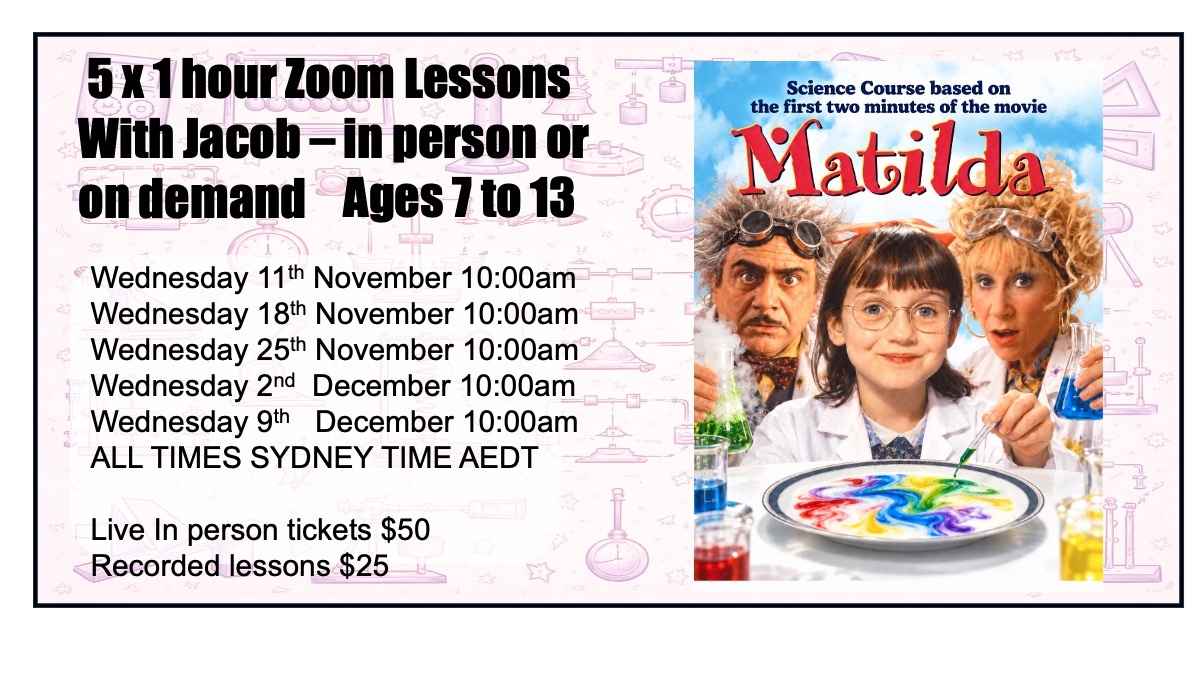
Five one hour online (Zoom) Science Lessons based on the Movie Matilda (Well the first 2 minutes of it to be strictly accurate!)
There is no Tiny Science Lab equipment required to participate in this course (Although having a Junior Chemistry Set one and Two, or a General Science Set wouldn't hurt)
Equipment and consumables used will mostly be found at home
Live tickets $50 - total price for 5 lessons (Also receive the links to the recorded lessons)
On-demand recorded ticket - $25 for 5 lessons
Wednesday 11th November 10:00am
Wednesday 18th November 10:00am
Wednesday 25th November 10:00am
Wednesday 2nd December 10:00am
Wednesday 9th December 10:00am
ALL TIMES SYDNEY TIME AEDT
These lessons will be recorded and the link sent to the ticket purchaser so that if you miss a lesson you can catch up. Note: The recorded lessons will only available until the end of 2026.
To participate:
1. Buy a Ticket to this event ($50) - One ticket per login.
eg. A family of three kids gathered around a single device = 1 ticket
eg A family of three kids with three separate devices = 3 tickets
eg A group that of 8 homeschool kids meeting at someones house with a device at the end of the table or a big screen TV = 1 ticket.
2. Printout the worksheets which will be emailed out closer to the course.
3. Participants will need the worksheets, pen and a few extras from around the house for each lesson.
What we will be covering in this course:
Science Concept 1: Matilda is born!
Gestation time.
Activities:
i. Fill in a data table of gestation time for a variety of mammal offsprings compared to humans including average mass of adult, average mass of young, average life expectancy, number of legs.
Complete a column graph showing the gestation times for a range of mammals compared to humans.
Complete a scatter graph of average mass of adult versus gestation time
Homework task: Complete a scatter graph of average life expectancy versus gestation time
ii. Eye colour of babies.
Eye colour of participants in the class. Complete a data table. (Structure of the eye is covered in a future lesson)
What are some other hereditary traits in humans? Complete a data table.
Homework task: Completing the hereditary data table for other family members.
iii. Gummy bear genetics.
Complete an activity with gummy bears to show genetic inheritance.
iv. Identical twins have the same genetic code, but do they have the same thumbprints?
Participants investigate their own finger prints using graphite powder from grey lead pencil shavings.
Science Concept 2: Soap
i. What is water. Properties of water. Chemical properties of water including dissolving of sugar/salt
ii. Water is not good at wetting things because it likes to stick together!
iii. Water is not good at dissolving oils and grease (constituents of ‘dirt’)
iv. What is soap? Properties of soap / detergent. Chemical properties of soap/detergent including dissolving sugar/salt
v. Soap/detergent helps water wet things.
vi. Soap/detergent helps water dissolve grease and oils
vii. The classic milk, food colouring, detergent spiral in a bowl
Science Concept 3: Hot car and cooling with a fan
i. What is heat? How do we measure it?
ii. How hot can cars get in the sun with their windows closed? Let’s find out.
iii. Why is the brother fanning himself? Make a paper fan and find out.
iv. What is evaporation and evaporative cooling?
v. Is the fan the brother using also a Japanese hand drum? Can we make one?
Science Concept 4 – Unsecured capsule in the back of the car.
i. Newtons first law – An object at rest tends to stay at rest, and an object in motion tends to stay in motion. Examples of this in real life
ii. Friction helps things move (and stop)
iii. Could the capsule spin as shown in the movie?
Science Concept 5 – Innovation inspired by the speedhump
i. Why do we slow down for speedhumps?
ii. Can we make a speed hump using Oobleck?
Note: Jacob will teach all of these concepts in an age appropriate and sensitive manner.
Like many of his courses it's always great fun to have parents and siblings on the outer edges. Warning though, Jacob sometimes likes to involve you too in the lesson!