
Good Science Years 9 & 10 - Forces - Waves & Motion
Location
Online event access details will be provided by the event organiser
About
Please note: fyi gmail email addresses seem to be the most reliable in terms of me sending information to you (hotmail, yahoo and outlook often seem to bounce back)
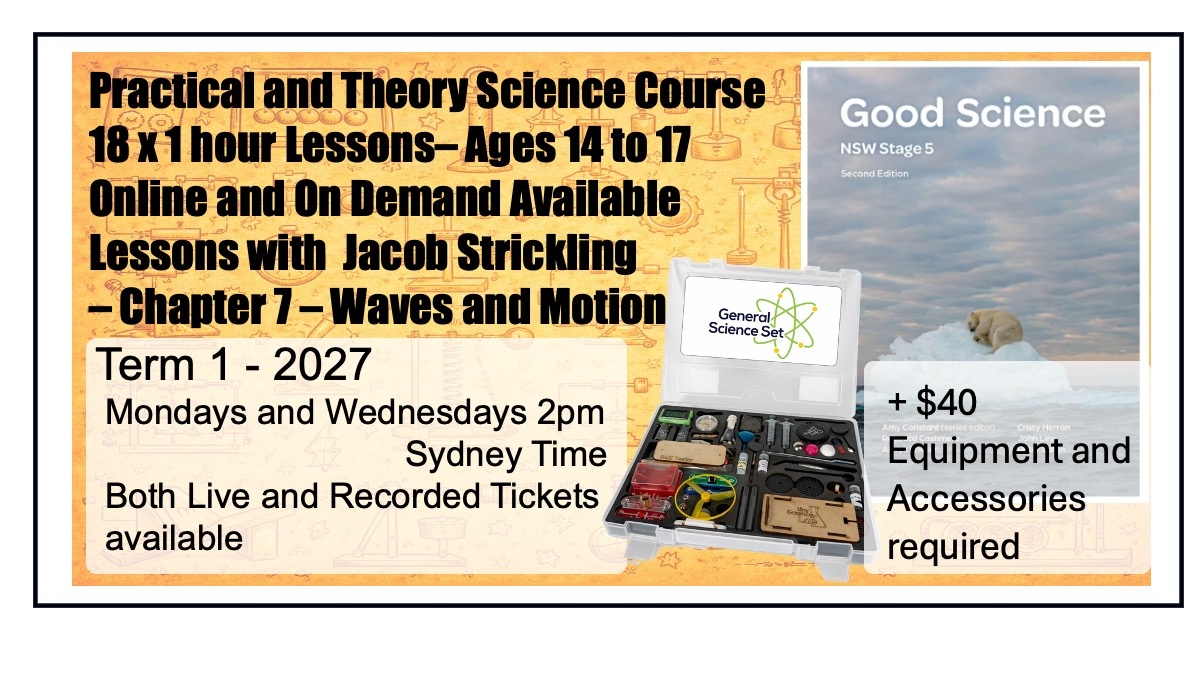
What: 18 x Live Online and On Demand Science lessons based on the Year 9 and 10 Good Science Textbook - Chapter 7 Waves and Motion (A Physics Topic)
Who: Students of Years 9 or 10 High School Age
There are no pre-requisites for completing this course. You do not have to had completed any other courses in this series. They are all stand-alone courses.
When: 2027 Term 1 Live Online Monday's and Wednesday's starting the 1st February at 2pm to 3pm Sydney Time
On Demand lessons at a time that suit your family
Why: This is a complete theory and practical Science course. Students will require to spend about 1 hour of preparation before the lesson and 1 hour of post work after the lesson. The text book will be used to complete this learning.
The lessons themselves will consist of practical work, demonstrations, discussions and explanations.
Cost: $270 for the 18 Live Lessons (you get access to the recorded lessons as well)
$135 for the 18 Recorded On Demand Lessons
Requirements to participate in this Course:
1. A Ticket - either:
i. A ticket to the Live Online Classes - 18 lessons for $270
Note: A ticket is for a single login - you can have multiple participants around a single device (Upto a maximum of 3)
Classes will be recorded and a link to the recorded lessons will be sent soon after the live lesson finishes.
OR
ii. A ticket to the On Demand classes (Link to the recorded lesson sent soon after the live lesson finishes)
If you have a child who is too shy to participate in the live class, or you will miss too many live classes, or live lessons are out of your budget, then this ticket is perfect for you.
18 lessons for $135
2. Textbook Required (Paper or Digital version is perfectly adequate)
Hardcopy and Digital $90 OR Digital only $30
Good Science NSW Stage 4 2e Student Book + Digital (for the new NSW 7-10 Science syllabus) - Note this textbook covers all of V9.0 Australian Curriculum Science Years 7 and 8.
Note: It is perfectly satisfactory for participants to just have the digital version.
This course, Term 1 we will be working our way through Chapter 4 - Solutions and Mixtures
NOTE: To download the digital version, when you setup your account with matilda eduction, for the school option choose 'Other' and your personal email address is satisfactory (an education/school email address is not necessary.
3. Equipment required from Tiny Science Lab:
Either :
i. The General Science Set ($195) Link to General Science Set
OR
The Physics Set for High School ($175) Link to Physics Set for High School
ii. The Good Science Accessories Pack for Chapter 7 Waves and motion ($40)
4. There will be some extra equipment and substances required for different lessons but in virtually all cases you will already have these at home.
5. The classes will generally include teaching, demonstrations, questions and answers, discussion and hands-on practical activities.
6. There will be activities 'homework' set which the participants will be expected to do prior and after each online class. This will involve reading, taking down notes, writing questions, getting materials ready, answering questions and completing practical work.
In total this will be about 1 hour before the lesson and 1 hour after each lesson.
7. Dates and Times
All times Sydney times
1st February to Saturday 3 April AEDT — Australian Eastern Daylight Time (UTC+11)
From Sunday 4 April AEST — Australian Eastern Standard Time (UTC+10)
Lesson 1: Monday 1st February 2pm
Lesson 2: Wednesday 3rd February 2pm
Lesson 3: Monday 8th February 2pm
Lesson 4: Wednesday 10th February 2pm
Lesson 5: Monday 15th February 2pm
Lesson 6: Wednesday 17th February 2pm
Lesson 7: Monday 22nd February 2pm
Lesson 8: Wednesday 24th February 2pm
Lesson 9: Monday 1st March 2pm
Lesson 10: Wednesday 3rd March 2pm
Lesson 11: Monday 8th March 2pm
Lesson 12: Wednesday 10th March 2pm
Lesson 13: Monday 15th March 2pm
Lesson 14: Wednesday 17th March 2pm
Lesson 15: Monday 22nd March 2pm
Lesson 16: Wednesday 24th March 2pm
Lesson 17: Monday 29th March 2pm
Lesson 18: Wednesday 31st March 2pm
8. Teaching Facilitator: Jacob Strickling
Jacob is a passionate Science Educator who believes hands-on practical learning is the key to a good Science education. He has a Mechanical Engineering degree, taught Science in High School for many years, established Make Science Fun and Tiny Science Lab, and along with his wife Rachel, has home educated their two youngest children through their high school years.
Jacob has a teaching philosophy of directed learning.
Jacob's Science lessons provide a 'safe' space for all families
(**See more on this at the bottom of this page**)
9. It is anticipated that Jacob will continue to offer courses based on the textbook and equipment throughout 2027
Term 1 - Mondays and Wednesdays 2pm - Chapter 7 Waves and motion (Physics)
Term 2 - Mondays and Wednesdays 2pm - Chapter 3 Materials (Chemistry)
Term 3 - Mondays and Wednesdays 2pm Chapter 2 Disease and Chapter 5 Genetics
Term 4 0 Mondays 2pm Chapter 1 Energy
Some possible asked questions (PAQ's)
1. Can my child who is younger than 14 do this course?
Depending on their abilities Jacob advises that no child younger then 14 participates in this course.
2. Do I need to supervise my children doing this course?
You will be supplying the equipment and you know your child and circumstances best. A parent should be nearby within supervision reach.
3. Do participants need the camera on?
It is preferable as Jacob can have greater interaction with the participants if he can see them.
4. How long are the recorded lessons available for?
It is anticipated that they will remain available for upto 6 months after the course is completed
5. Where is the best location for participants to complete the course?
A dining room table is probably best.
6. If I miss a lesson, how do I catchup?
All ticket holders receive an email after each class with the recorded lesson link.
7. Does my child have to complete the preparation and homework for each class?
It's best if they do.
8. Do you offer a payment plan?
Sorry no. However, there is a significantly reduced ticket price option for the recorded lessons.
9. Is the 'Good Science' textbook from matilda education any good?
Jacob thinks it's very good and very extensive
10. I have agroup of 6 students who want to participate, how many tickets do I need to buy?
It's 1 ticket per login with a maximum of 3 students around one device. You would need to purchase 2 tickets.
11. Hang on! This textbook says 'NSW Textbook' and I'm not from NSW!
11. Hang on! This textbook says 'NSW Textbook' and I'm not from NSW!
Should we still sign up?
Absolutely! Jacob chose this text book for two reasons - it is very comprehensive and the digital version is excellent value. This text book covers all of the Australian Curriculum V9.
12. I've purchased the Digital textbook and it wants to know my school and school email??
Choose 'Other' for the school and you can use your personal email address.
**Homeschooling families come from many different backgrounds and hold a variety of beliefs and worldviews. One of the wonderful things about homeschooling is that parents remain the primary educators of their children.
Jacob's goal is to create a welcoming and respectful learning environment for every family. His lessons focus on developing scientific thinking through observation, experimentation, measurement, problem-solving, and critical thinking.
From time to time, we may explore topics where people hold different interpretations or beliefs. When this happens, Jacob's role will not be to persuade students to adopt a particular worldview or philosophy. Instead, his aim to present scientific ideas respectfully and encourage students to ask thoughtful questions while recognising that many families prefer to discuss broader philosophical or theological questions at home.
Jacob believe's science is at its best when it inspires curiosity, encourages careful observation, and equips students to think critically. His hope is that every family feels comfortable participating, knowing their beliefs will be treated with respect, while still informing them about other world views and philosophies, when required by the topic.