
Geoffrey Lehmann - Picking Nasturtiums & Nero's Poems
About
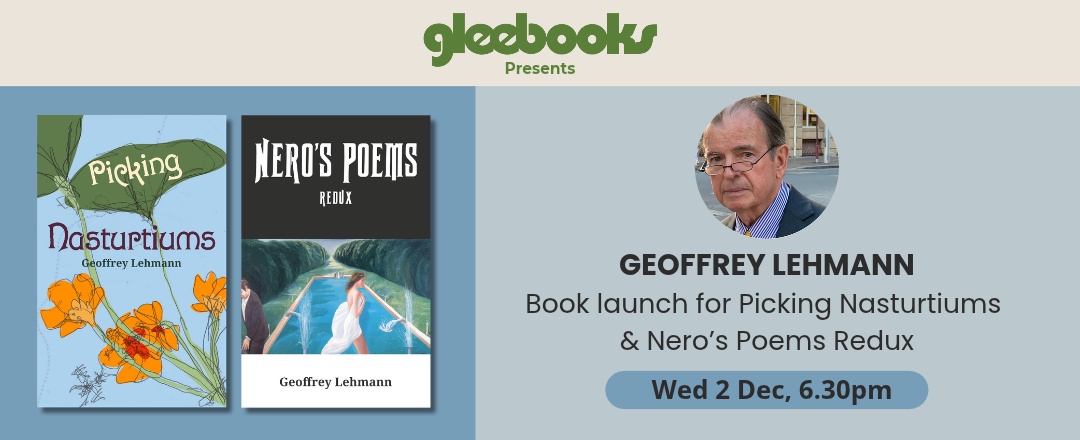
Join us for the launch of Picking Nasturtiums and Nero's Poems Redux by Geoffrey Lehmann.
Picking Nasturtiums
The 128 poems of Picking Nasturtiums are the summation of Geoffrey Lehmann’s more personal poems.
Highlights include “An Image”, still as it was in 1959, and many early poems with small variations. Among these are “The Last Campaign”, once a popular anti-war anthology piece, which the poet discarded for many years because of flaws – now fixed – and the final and definitive “Meditations of Marcus Furius Camillus, Governor of Africa”. Mainly about dolphins and lions, these “meditations” are what the poet likes best among his poems, as did Roy Fuller, who described them as “a highly rewarding feat of imagination”.
Also of note are some new poems. “At Currarong” imagines a young girl finding the dead bodies of thousands of migrating mutton birds on a beach. “The Inequality of Sprawl” has a hilarious slant on the events giving rise to Les Murray’s famous poem “The Quality of Sprawl”. “Anita Russakova Walking to the Gulag” describes Victor Serge’s sister-in-law walking through the snow in her blue shoes to a Soviet prison camp.
Written during the COVID epidemic, “The Nature of Things”, sees viruses as “the night workers in the supermarket” and welcomes our “many nationalities”, our “many sexualities”, as “not survival of the fittest”, but “survival of the adequate” – “The viruses are us. We are them.”
Nero's Poems Redux
First begun in 1974, Nero’s Poems Redux is a book of autobiographical poems of the Roman emperor Nero. These are astonishing, yet invented translations, as only fragments of Nero’s own poetry survive.
At the heart of this strange book are Nero’s love of beauty and his famous last words: “Qualis artifex pereo.” – what an artist dies with me – and the paradox of a mother’s boy who murders his controlling mother. A more attractive person emerges than one might expect. He celebrates Rome’s gardens and beggars. He delights in dinner parties: “If gods can visit men, they do at dinner among friends.” On the death of his much loved empress Poppaea, he imagines himself as a new Orpheus seeking her in the underworld.
Geoff Page in Sydney Review of Books wrote of an earlier published version of these “translations”: “Geoffrey Lehmann . . . has been the most protean Australian poet of his generation, a user of masks . . . Nero’s poems are . . . a milieu in which he seems able to move effortlessly, quietly implying parallels with our own times while also insisting on Rome’s uniqueness . . . The poems can be confronting, but they give a strong sense of a powerful man out of control, a man who will eventually be destroyed by his own excesses.”
Geoffrey Lehmann was born in 1940 in Sydney. In 1959 his poem 'An Image' was published in the London Magazine then anthologised in The Guinness Book of Poetry 1958/59. In 1965 he shared his first book of poems, The Ilex Tree, with Les Murray. As well as poetry, he has published a novel, two children’s books, and edited and co-edited five anthologies of Australian poetry. He was the first Australian poet published by Faber and Faber with his Spring Forest being shortlisted for the T S Eliot Prize. His Poems 1957-2013 won the Australian Prime Minister’s Prize 2015.