
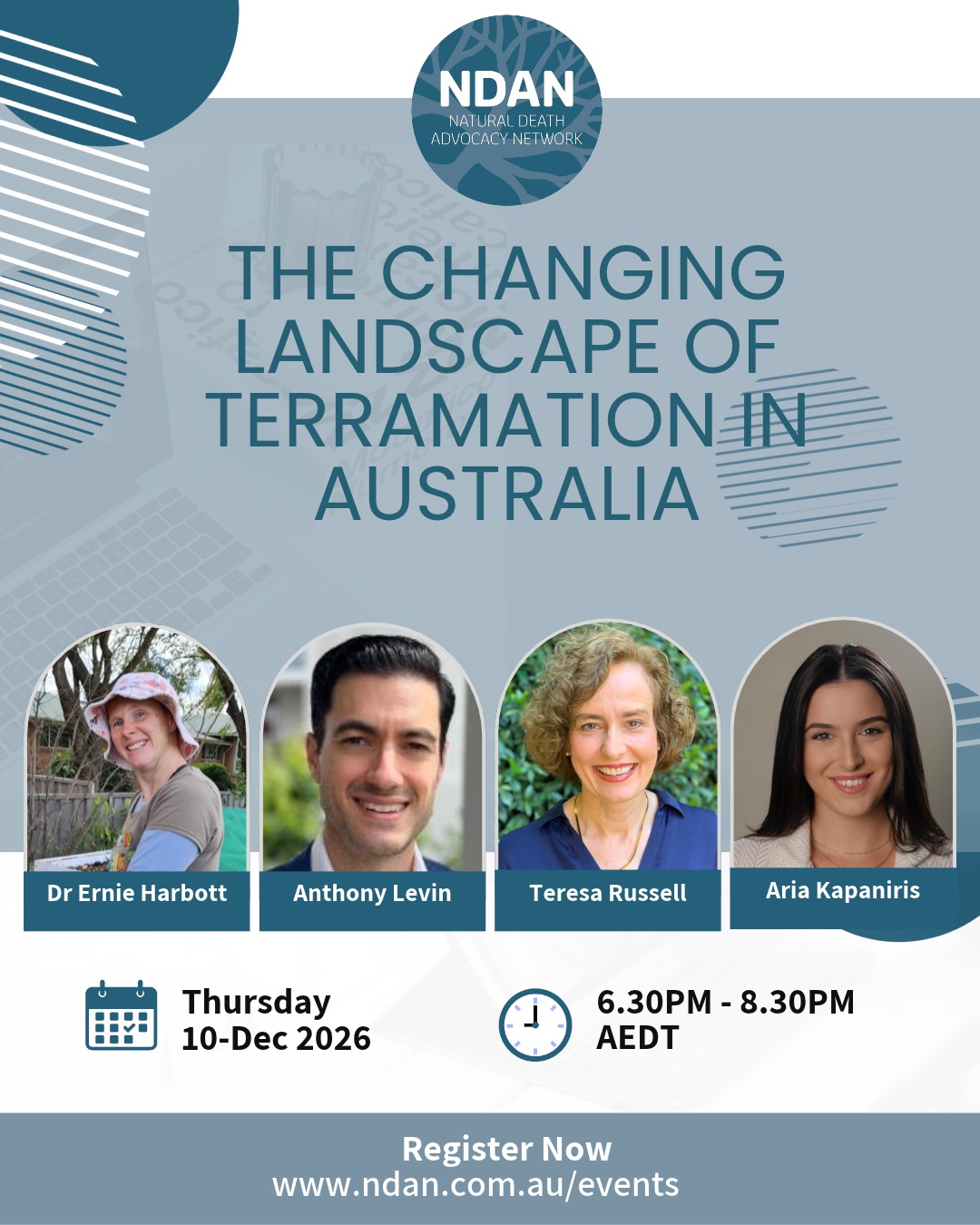
The Changing Landscape of Terramation in Australia
Location
Online event access details will be provided by the event organiser
Hosted by
About
The legislation is a milestone.
The next phase matters.
Natural Death Advocacy Network (NDAN) invites you to a timely panel discussion exploring Terramation, also known as human composting, and natural organic reduction (NOR), and what happens next following a significant legislative milestone in New South Wales.
In October 2026, the Public Health Amendment (Terramation) Bill recognising human composting as an additional form of after-death disposition passed both houses of the NSW Parliament and received formal assent. This marks an important step towards expanding the choices available to people after death.
Schedule 1.2 of the legislation amends the Public Health Regulation 2022 to allow a reduction controller, at a reduction facility, to compost a body from the day that is 18 months after the date of assent. The period leading up to this commencement provides time for the regulatory framework and practical arrangements to be developed.
What needs to happen during this next phase?
Can community voices contribute to the process?
And how can Australia learn from international experience while working towards an approach that is safe, ethical, environmentally responsible and accessible?
Bringing together expertise in composting, human rights, advocacy and learnings from international facilities, this panel will explore the science and practice of composting, the legal and regulatory pathway ahead, the advocacy that helped bring about legislative change, and the opportunities and challenges involved in establishing terramation in Australia.
The conversation will consider what responsible implementation might look like, how equitable access can be prioritised, and what can be learned from experience in other countries.
Meet the panellists
Dr Ernie Harbott, Compost Culture
Dr Ernie Harbott has degrees in Chemistry and Environmental Science, a PhD in Biogeochemistry, and experience spanning teaching, water chemistry and composting. Founder of Compost Culture, she is a passionate advocate for healthy soils, soil regeneration and local, small-scale composting.
Ernie brings a scientific and practical understanding of composting, organic matter and ecological cycles.
Anthony Levin, Human rights lawyer and co-host of Grave Matters
Anthony Levin is a human rights lawyer and co-host of the SBS podcast Grave Matters. His work and interests span access to justice, discrimination, civil liberties and the rights of people experiencing disadvantage. Anthony brings a legal and human rights perspective to questions of dignity, informed choice, equity and ethics for new after-death options.
Teresa Russell, Founder, Earthly Legacy
Teresa Russell is the founder of Earthly Legacy, a new non-profit organisation, and was a key campaigner in the movement to legalise human composting in NSW. With a background in nursing, healthcare marketing and business, she has also helped establish the charity Primary Ethics, serving as its founding CEO. Teresa has closely followed the development of natural organic reduction in the USA, holds USA certification as a Natural Organic Reduction Operator, and has completed a Certificate IV in Funeral Services through Tender Funerals Australia.
Aria Kapaniris, Founder and CEO, Evergrove
Aria is the Founder and CEO of Evergrove, Australia’s first terramation company and a social enterprise that played a central role in legalising terramation in NSW. Evergrove was born from Aria’s experience of losing her grandmothers and her mum. Since 2023, she has authored the regulatory framework submitted to NSW Health and the leading public discussion paper on terramation, played a key role in the 2025 petition to Parliament, and seen all her recommendations reflected in the final Bill. She was a keynote speaker at TerraCon 2026 in Seattle and has featured in national media including ABC and SBS. As a UTS business alumna with nearly a decade of experience in strategy and delivery, Aria has dedicated her career to understanding how we bring about social and environmental change at scale through behavioural science, human-centred service design and systems thinking.
What happens next?
The passage of legislation is an important milestone, but it is only one step towards making terramation available in practice. The coming months will be important for working through the regulatory requirements, considering appropriate safeguards and ensuring that community interests are part of the conversation.
Join us to explore the questions still to be worked through, what Australia can learn from international experience, and how this new option might become an informed and accessible choice.
This event will be of interest to death-care workers, funeral professionals, policymakers, advocates, environmental practitioners, community educators and anyone interested in expanding informed, environmentally conscious choices for what happens to our bodies after death.