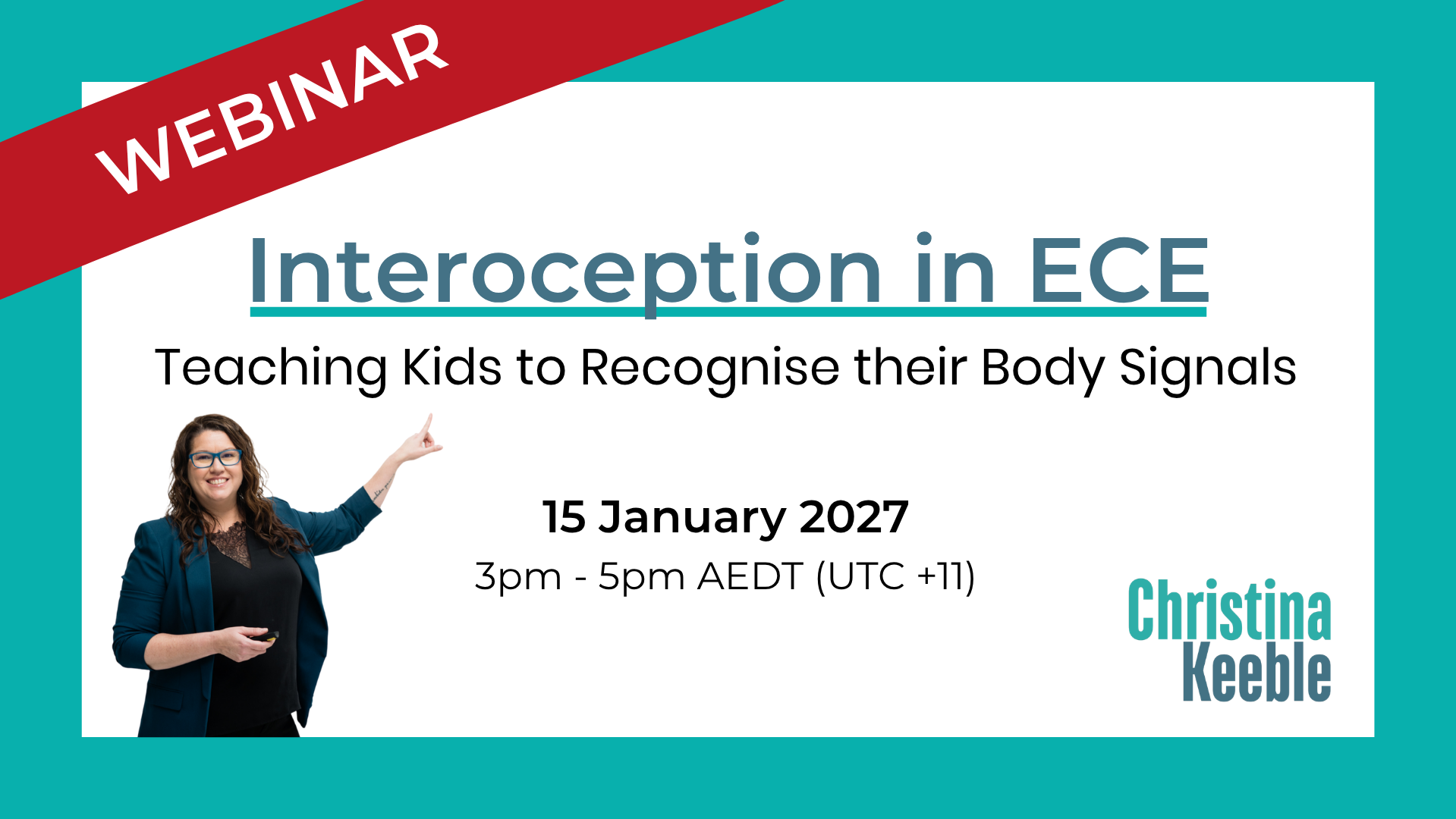
Join Christina Keeble & Stephanie Robertson for this important webinar on how teaching children to listen to their body signals is a critical protective factor.
Children’s bodies are constantly communicating through sensations, emotions, and internal and external body cues of comfort, discomfort, safety, and threat. When children are supported to listen to and trust these body signals, they develop a strong foundation for emotional intelligence, self-advocacy, personal safety, which facilitates the development of self regulation.
When children’s interoceptive experiences are dismissed, overridden, or invalidated when they are dysregulated or in distress, or they are encouraged to ignore their perceived discomfort and related body signals, this can lead to them learning to mistrust their own bodies.
It is not uncommon to hear someone tell a child who has fallen and scraped their knee that they "are ok"; or to hear them say to a child who is crying because they've just been dropped off at childare, kinder, or school and miss their parent that they "will be ok, there is no need to cry, we will have fun." While these platitudes come from a place of care and support, they unintentionally undermine a child's perception of their experience.
Over time, these repeated experiences can lead children to look externally to others for validation, guidance, and permission, increasing vulnerability to manipulation, coercion, and victimisation. Children with disabilities, including neurodivergent children are at an increased risk of victimisation across their lifespan.
This session explores interoception as a critical protective factor.
Attendees will learn why interoceptive awareness must be explicitly taught, how children develop internal cues of safety and threat, and how parents, carers, teachers, educators, and therapists can support children to respond to their body signals with confidence and care.
Through practical, everyday examples, this presentation equips attendees with the tools to help children build body trust, empowering them to recognise discomfort, communicate needs, set boundaries, and seek support when something does not feel right.
Christina Keeble is a neurodiversity and educational consultant specialising in teaching and supporting neurodivergent children and teens, she is a registered early childhood and primary teacher, published researcher, a parent to two neurodivergent PDAers and a late diagnosed Autistic/ADHD adult with over 20 years experience supporting neurodivergent children and their families. Christina has a BA Honours (Psychology), DipEd in Early Childhood & Primary Teaching, and a Masters in Special Education.
Steph Robertson is an experienced multiply-neurodivergent occupational therapists, speaker and advocate, with a commitment to for trauma responsive and neurodiversity-affirming practice. She holds a Bachelor degree of Occupational Therapy and a Master degree of Advanced Occupational Therapy Practice where she completed a research study into parents' and carers' experience of family centered practice in early childhood intervention. Steph has over a decade of experience. As an autistic, ADHD, cPTSD individual, Steph draws on her professional, research and lived experience in her work.
Digital notes provided. Q&A session at the end. Certificate can be requested.
This webinar will be recorded for those who can't attend the live event and will be available for 30 days.
The live event will be broadcast from Melbourne, Australia. Please use this link to calculate the time in your timezone: https://www.timeanddate.com/worldclock/converter.html