
Photophilia - Daylight for Architectural Plantings
Introduction:
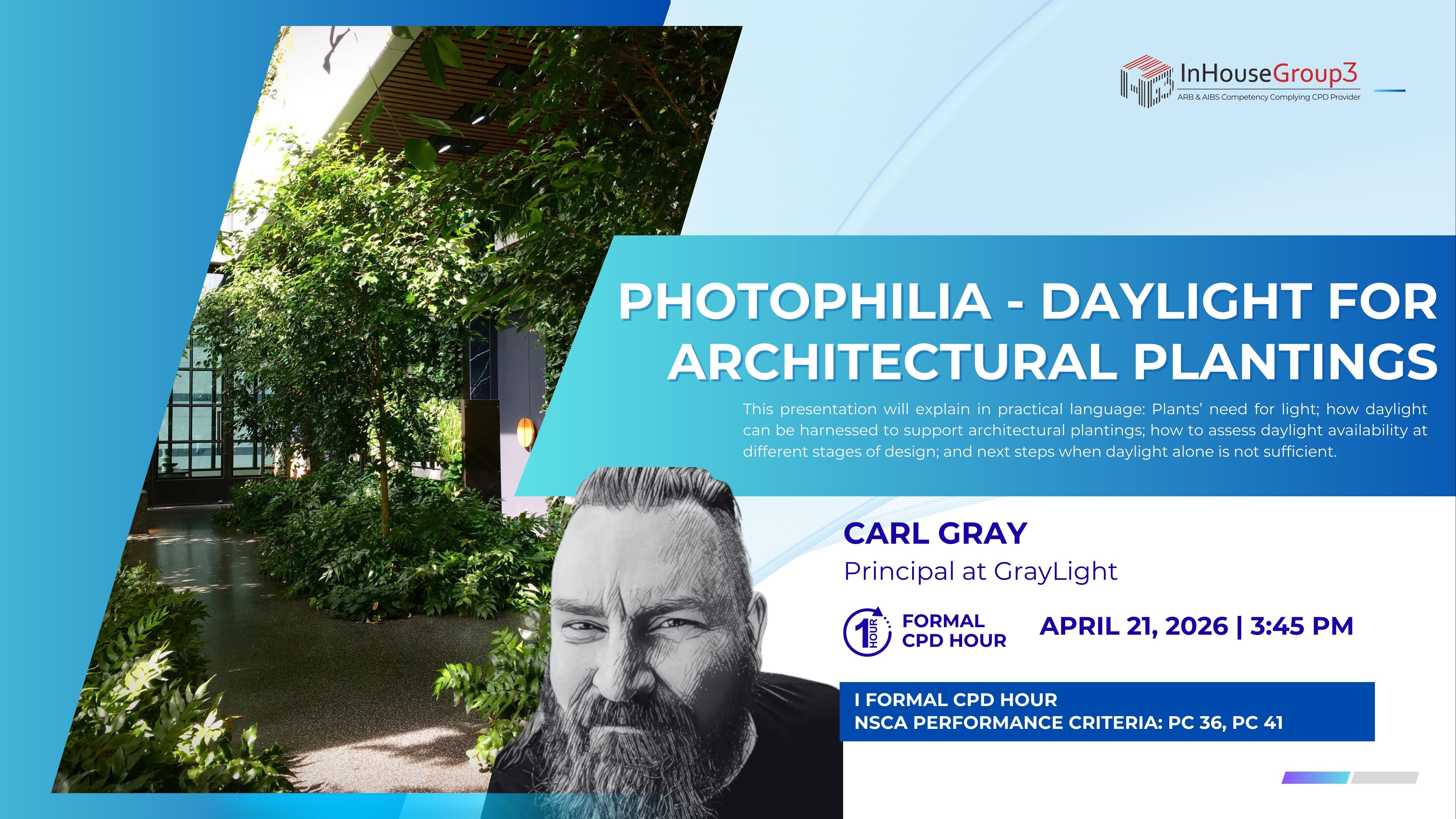
Architects, allied professionals, and their clients have become increasingly ambitious in the incorporation of plants into the built environment.
Having mastered the simple ‘green wall in the lobby; plantings to ‘green facades’, ‘outdoor rooms’, ‘sky terraces’ and atria are becoming the norm. An increased focus on street activation has led to more semi-indoor plantscapes. And beyond just understorey shrubs, more demanding species such as trees and grasses are creeping in to planting palettes.
Plants of course need light to grow – and typically lots of it! Daylight is the most desired source of this light; but determining the quantity (and quality) of daylight available, versus what the plants need, can be challenging.
The presenter will explain in practical language: Plants’ need for light; how daylight can be harnessed to support architectural plantings; how to assess daylight availability at different stages of design; and next steps when daylight alone is not sufficient.
----------------
AT THE END OF THE PRESENTATION ATTENDEES WILL BE ABLE TO:
- Understand plants’ lighting needs (amount, spectrum, and timing);
- Know the metrics used to quantify plant-specific lighting.
- Use simple tools and techniques to pre-assess daylight availability early in design;
- Be aware of the tools and techniques for plant-specific daylight analysis.
Architects, allied professionals, and their clients have become increasingly ambitious in the incorporation of plants into the built environment.
Having mastered the simple ‘green wall in the lobby; plantings to ‘green facades’, ‘outdoor rooms’, ‘sky terraces’ and atria are becoming the norm. An increased focus on street activation has led to more semi-indoor plantscapes. And beyond just understorey shrubs, more demanding species such as trees and grasses are creeping in to planting palettes.
Plants of course need light to grow – and typically lots of it! Daylight is the most desired source of this light; but determining the quantity (and quality) of daylight available, versus what the plants need, can be challenging.
The presenter will explain in practical language: Plants’ need for light; how daylight can be harnessed to support architectural plantings; how to assess daylight availability at different stages of design; and next steps when daylight alone is not sufficient.
----------------
AT THE END OF THE PRESENTATION ATTENDEES WILL BE ABLE TO:
- Understand plants’ lighting needs (amount, spectrum, and timing);
- Know the metrics used to quantify plant-specific lighting.
- Use simple tools and techniques to pre-assess daylight availability early in design;
- Be aware of the tools and techniques for plant-specific daylight analysis.
Location
Online event access details will be provided by the event organiser


Contact Form
Photophilia - Daylight for Architectural Plantings

Resend recently purchased tickets to our events to your email.
Enter email to start search
You can review the event organiser's terms and conditions here.