
TCM and Chinese reflexology
About
Online Traditional Chinese Medicine (TCM) & Chinese Reflexology CourseSmall Group Delivery | Chinese or English | Certificate of Attendance
This online course offers a comprehensive introduction to Traditional Chinese Medicine (TCM) principles and Chinese Reflexology, delivered in a supportive small-group learning environment. Designed for beginners as well as wellness practitioners seeking to deepen their understanding, the course combines classical theory with practical, hands-on techniques that can be applied safely and effectively.
The course is delivered live via Zoom, allowing real-time interaction, demonstrations, and guided practice. To ensure a high level of personal support, class sizes are kept intentionally small. Teaching is available in Chinese or English, and learners may choose their preferred language at registration. A Certificate of Attendance is provided upon completion.
Course Aims and Learning Outcomes
By the end of the course, participants will:
Understand the foundational theories of Traditional Chinese Medicine
Learn the principles and history of Chinese Reflexology
Identify key reflex zones and their relationship to organs and systems
Apply reflexology techniques for relaxation, balance, and self-care
Gain practical skills that can be used personally or as a complement to other wellness practices
Develop confidence in basic assessment and treatment planning
Understand safety, ethics, and professional boundaries
Course Structure and Delivery
Format: Live online sessions via Zoom
Group Size: Small groups only for fully supported learning
Language: Chinese or English (chosen by participants)
Materials: Digital handouts, diagrams, and guided practice notes
Support: Live Q&A, demonstrations, and individual feedback
The Zoom link is sent 24 hours before the session begins. Participants are encouraged to attend from a quiet space where they can comfortably observe demonstrations and practice techniques.
Module 1: Introduction to Traditional Chinese Medicine
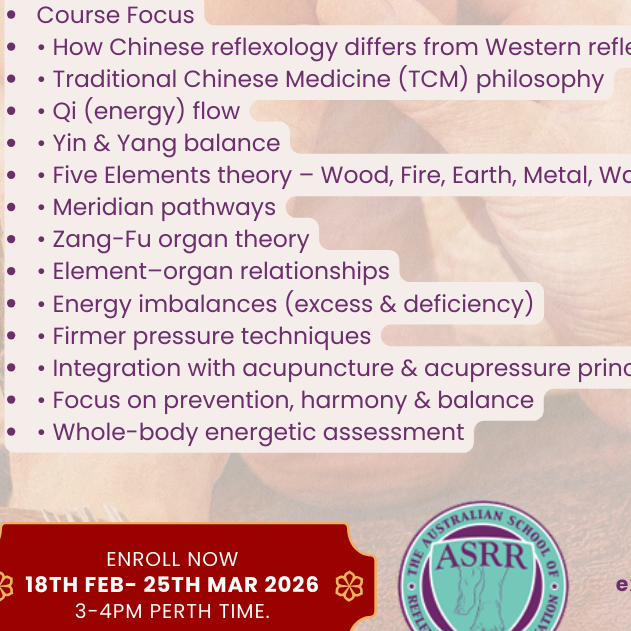
This module introduces the philosophy and historical development of TCM. Students will explore how Chinese medicine views the body as an interconnected whole rather than separate systems.
Topics include:
Overview of TCM history and evolution
The holistic approach to health and disease
Yin and Yang theory and balance
The Five Elements (Wood, Fire, Earth, Metal, Water)
How emotional, physical, and environmental factors influence health
Module 2: Qi, Blood, and Body Fluids
Participants will learn the core substances of TCM and their functions within the body.
Topics include:
Understanding Qi (vital energy)
Types of Qi and their roles
Blood and Body Fluids in Chinese medicine
Common patterns of imbalance
How stagnation or deficiency affects wellbeing
Module 3: Meridian Theory and Organ Systems
This module focuses on the meridian (channel) system and the Zang-Fu organs.
Topics include:
Introduction to the meridian network
Relationship between organs and reflex zones
Functional roles of Zang (Yin) and Fu (Yang) organs
External and internal connections
How meridians relate to reflexology practice
Module 4: Foundations of Chinese Reflexology
Students are introduced to the principles, history, and philosophy of Chinese Reflexology.
Topics include:
Origins and development of Chinese Reflexology
Differences between Chinese and Western reflexology approaches
Reflex zones of the feet, hands, and ears
Organ and system correspondence
Indications and limitations of reflexology
Module 5: Practical Reflexology Techniques
This hands-on module focuses on learning and practicing core reflexology methods.
Topics include:
Proper posture and hand techniques
Pressure application and rhythm
Locating and working key reflex points
Relaxation and grounding techniques
Guided self-practice and partner demonstrations (where appropriate)
Participants are guided step-by-step to ensure safe and effective technique development.
Module 6: Assessment and Treatment Planning
This module introduces simple, non-diagnostic assessment skills based on TCM principles.
Topics include:
Observing reflex sensitivity and texture
Understanding common reflex patterns
Creating a basic reflexology session plan
Adapting techniques for individual needs
Supporting balance and relaxation
Module 7: Safety, Ethics, and Professional Practice
Students will learn essential safety guidelines and ethical considerations.
Topics include:
Contraindications and precautions
Working within scope of practice
Client communication and consent
Hygiene and professional standards
Self-care for practitioners
Module 8: Integration and Self-Care Applications
The final module focuses on integrating learning into daily life or professional practice.
Topics include:
Reflexology for stress management
Supporting sleep, digestion, and circulation
Creating a personal self-care routine
Combining reflexology with other wellness approaches
Review and consolidation of course content
Certificate of Attendance
Participants who complete the course will receive a Certificate of Attendance, confirming hours of study and participation. This certificate is suitable for personal development records or complementary wellness education (non-clinical).
Who This Course Is For
Beginners interested in TCM and reflexology
Wellness practitioners seeking additional skills
Massage therapists, yoga teachers, and holistic therapists
Individuals interested in self-care and natural health
Those wishing to learn in Chinese or English in a small, supportive group
Location
Online event access details will be provided by the event organiser
Contact Form
TCM and Chinese reflexology

Resend recently purchased tickets to our events to your email.
Enter email to start search
You can review the event organiser's terms and conditions here.