
The Fascia Course - Paolo Tozzi
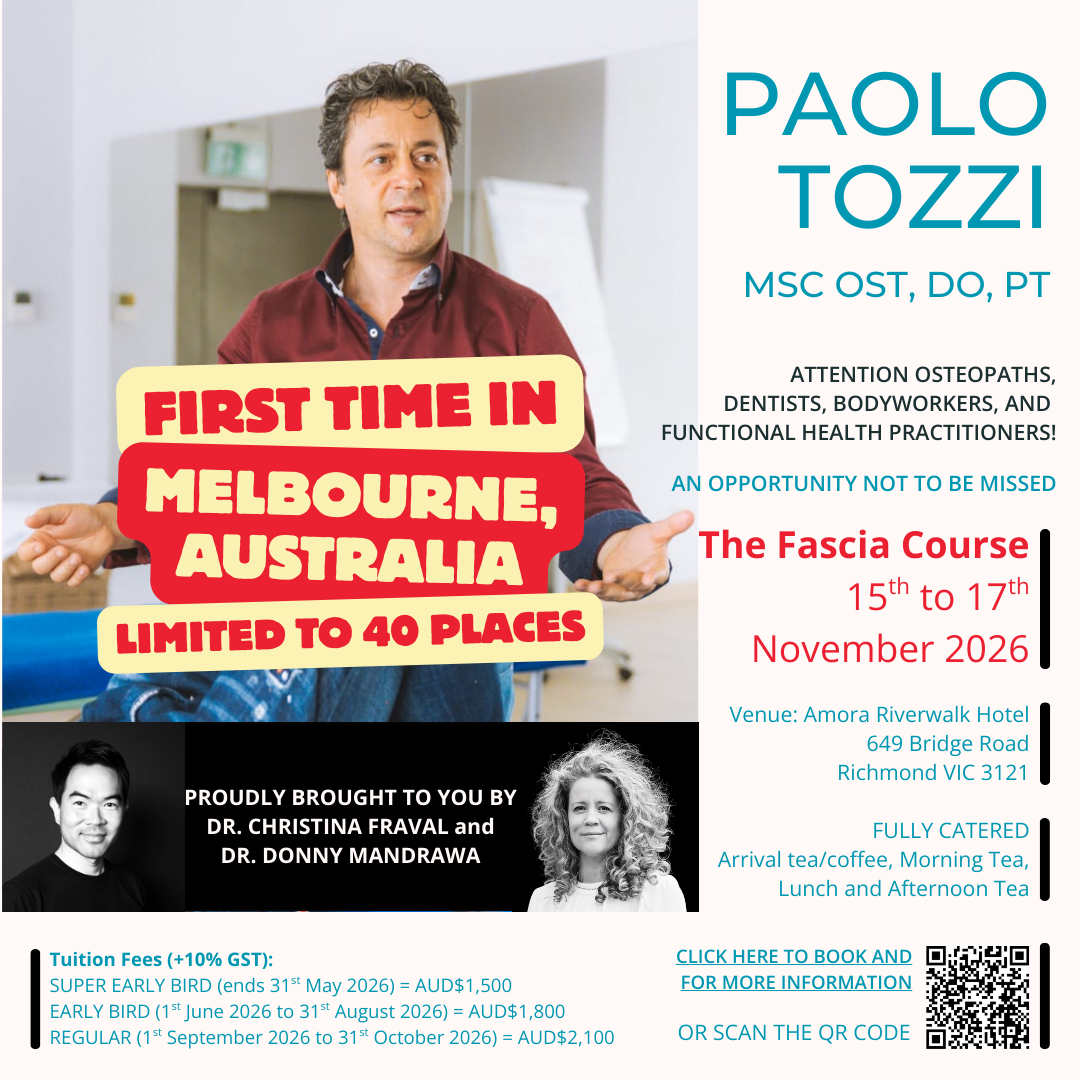
Location
About
As a structural element of the body connective system, fascia can be considered as a ubiquitous tissue permeating the whole organism. It seems to respond to cellular and macroscopic lines of tension by reorganizing itself accordingly. From this perspective, the repercussion of a fascial restriction will be body-wide, and may potentially create stress on any structure enveloped by fascia itself. Osteopathic fascial treatment aims to release such tensions, to restore function and to balance the inherent body mechanisms, and is often proposed as an adjunctive treatment for various conditions.
This course will offer an overview of the most common fascial techniques used within the osteopathic armamentarium, together with their different forms of application, ranging from indirect, direct to combined methods.
To guide the clinician through the understanding and the application of such fascial tools, various evidence-based mechanisms as well as different hypothesis based on osteopathic principles will be proposed and discussed.
COURSE OBJECTIVES
• To present the connective tissue as the major bio-mechanical and bio-electrical mediator of the structure and function interrelationship;
• To propose various fascial mechanisms by which somatic dysfunction may be induced and maintained;
• To illustrate the most common fascial techniques in osteopathic practice;
• To propose different fascia-mediated mechanisms behind the OMT efficacy and effectiveness.
TECHNIQUES THAT WILL BE COVERED
1. The fascial continuum in its structure and function: introduction to the main anatomical and physiological properties of fascia
2. Dimensional palpation of the various connective tissue levels
3. The bioelectric approach: intention, attention, activation processes for fascial evaluation and treatment
4. The connective tissue from a tensegrity perspective: from the cellular level to the body level
5. Global and local tenso-compression test and treatment
6. The Zink test: evaluation and treatment of the central myofascial pattern
7. The fascial tubes system: assessment and balancing of the meningeal, visceral and axial fascial tubes
8. The fascial rhythm: evaluation of its properties and anomalies through general/remote and focal/local listening
9. The Fascial Unwinding: History, Principles, Methods of application
10. Practice of local and global fascial unwinding
11. Rationale, evidence, indications and counterindications of osteopathic fascial work
12. The Still Technique: History, Principles, Methods of application
13. The Still Technique applied to fascia
14. The osteopathic evaluation and treatment of scar tissue: local (gliding, pressure, tensility, rolling, motility), segmental (vertebral), global (cranio-sacral)
This course will offer an overview of the most common fascial techniques used within the osteopathic armamentarium, together with their different forms of application, ranging from indirect, direct to combined methods.
To guide the clinician through the understanding and the application of such fascial tools, various evidence-based mechanisms as well as different hypothesis based on osteopathic principles will be proposed and discussed.
COURSE OBJECTIVES
• To present the connective tissue as the major bio-mechanical and bio-electrical mediator of the structure and function interrelationship;
• To propose various fascial mechanisms by which somatic dysfunction may be induced and maintained;
• To illustrate the most common fascial techniques in osteopathic practice;
• To propose different fascia-mediated mechanisms behind the OMT efficacy and effectiveness.
TECHNIQUES THAT WILL BE COVERED
1. The fascial continuum in its structure and function: introduction to the main anatomical and physiological properties of fascia
2. Dimensional palpation of the various connective tissue levels
3. The bioelectric approach: intention, attention, activation processes for fascial evaluation and treatment
4. The connective tissue from a tensegrity perspective: from the cellular level to the body level
5. Global and local tenso-compression test and treatment
6. The Zink test: evaluation and treatment of the central myofascial pattern
7. The fascial tubes system: assessment and balancing of the meningeal, visceral and axial fascial tubes
8. The fascial rhythm: evaluation of its properties and anomalies through general/remote and focal/local listening
9. The Fascial Unwinding: History, Principles, Methods of application
10. Practice of local and global fascial unwinding
11. Rationale, evidence, indications and counterindications of osteopathic fascial work
12. The Still Technique: History, Principles, Methods of application
13. The Still Technique applied to fascia
14. The osteopathic evaluation and treatment of scar tissue: local (gliding, pressure, tensility, rolling, motility), segmental (vertebral), global (cranio-sacral)