
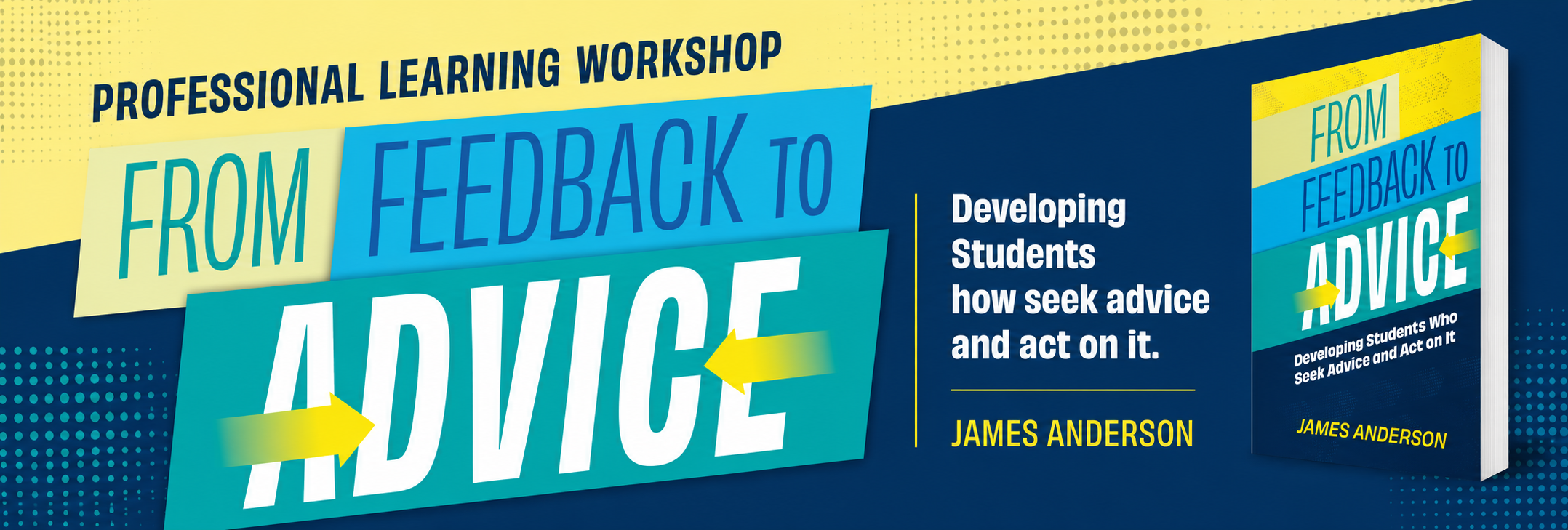
From Feedback to Advice -Developing Students Who Seek Advice
About
Stop writing feedback your students ignore.
Teach them to ask for the advice they actually need.
A hands-on, practical professional learning workshop for school leaders and teachers, based on the new book by James Anderson.
The world’s best teaching, multiplied by unskilled learning, still adds up to limited growth.
‘A superb book, and among the best on feedback.’ — John Hattie, Melbourne Laureate Professor Emeritus
The Cold Classroom Reality
You spend hours over the weekend writing thoughtful, detailed comments on student work. You highlight areas for improvement, suggest alternatives, and connect comments directly to success criteria.
Then Monday comes around.
You watch students glance at their grades for 30 seconds and shove the papers into their bags. Some make a quick fix. Most move on without a second thought.
Your feedback isn’t the problem. Quality feedback has one of the largest effect sizes in the entire research literature (d = 0.79) — and you are already skilled at providing it. The problem is that students have never been taught how to be effective partners in the feedback process.
They are operating as passive passengers in their learning, when they need to be taught to become skilled drivers.
This workshop will show you how to systematically release responsibility, build student ‘feedback literacy,’ and reclaim your weekend workload.
The Paradigm Shift: Feedback vs. Advice
At the heart of this workshop is a simple shift in language: Feedback finishes. Advice advances.
- The problem with ‘feedback’: In everyday use, the word ‘feedback’ has become contaminated with judgement. When students hear it, they expect criticism, prepare their defences, and wait passively to be evaluated.
- The power of ‘advice’: Advice is inherently forward-looking, constructive, and active. When students learn to seek advice at the moment they encounter struggle, they take control.
It costs nothing, it starts tomorrow morning, and it changes what students do with what you give them.
But the word is only the lever. It’s worth understanding what it moves.
The Shift That Actually Matters: Who Owns the Process
Effective feedback isn’t one act. It’s a seven-component process that runs continuously: setting the learning focus, clarifying success criteria, monitoring progress, gathering evidence, identifying feedback needs, formulating feedback, and acting on feedback.
In most classrooms, the teacher drives all seven. The student’s only job is step seven — and only if they feel like it.
The seven components never change. What changes is who drives them.
That’s the whole system. Through six developmental levels — from Dependence to Awareness, Participation, Collaboration, Leadership and finally Agency — responsibility for each component transfers deliberately, one stage at a time, from you to your students. It’s the same vehicle. What changes is who’s at the wheel.
This is why ‘student agency’ so often disappoints. Inviting students to own their learning, and then stepping back, isn’t a plan. Willingness and permission don’t make a student capable of running a process nobody has taught them to run.
Agency isn’t granted. It’s built. And it’s built one part of the learning process at a time. This workshop is about one of them: the capability to take charge of the feedback process — to work out what you need, ask for it, and act on it.
What We Will Cover: The Workshop Sessions
This is not a theoretical seminar. This is a practical, roll-up-your-sleeves planning workshop where you will analyse your current practice, explore the strategy toolkit, and build actual classroom templates for Monday morning.
Session 1: The Student-Led Feedback Diagnostic
- The shift itself: Cover the key ideas that take students from receivers of feedback to seekers of advice — why they ignore the comments they say they want, how a change in language changes who owns the process, and how to teach students to recognise the moment they actually need advice.
- The reality check: You will use the Student-Led Feedback Diagnostic to assess where your current students sit along the progression from Dependence to Agency.
- Locating your starting point: Pinpoint exactly where you and your classes operate across the seven components of the feedback process — setting the learning focus, clarifying success criteria, monitoring progress, gathering evidence, identifying feedback needs, formulating feedback, and acting on feedback.
- One stage ahead: Learn to pitch your next move just one stage beyond where students are now, so you build genuine progression instead of overwhelming them with choices they aren’t ready to make.
Session 2: The 5-Strategy Toolkit
You will be introduced to the five core strategies of the book. These five strategies remain consistent from Foundation to Year 12 — only the cognitive sophistication changes.
1. Teacher Prompts: Making expert thinking visible by narrating why we focus on specific advice.
2. T-Charts: Classroom-specific translation guides that teach students how to convert vague questions (‘Is this good?’) into precise requests (‘Does my evidence support my claim in paragraph 3?’).
3. Partner Checks: Peer-preparation routines (not peer assessment) that serve as a ‘pre-flight checklist’ to ensure students are prepared before they seek your advice.
4. Pre-Conversation Forms: Brief, structured preparation templates built with the FARES design tool (Focus, Attempts, Results, Examination, Support) that students complete to architect their consultations.
5. Advice Menus: Curated options built with the CLEAR design tool (Curriculum-connected, Learner-appropriate, Evidence-ready, Actionable, Reasonable in number) that offer students structured choice without analysis paralysis.
Session 3: Classroom Action Planning
- Minimum Viable Implementation (MVI): Don’t try to change everything. You will select just one or two strategies that match your students’ current readiness — consistency, not completeness.
- Co-developing your scaffold: Design your first subject-specific T-Chart and Advice Menu during the session.
- Drafting the action plan: Create a step-by-step roadmap to move your classroom from Level 1 (Give Feedback) to Level 4 (Co-develop Advice) — and beyond.
What You’ll Leave With
Every participant will walk away with a complete implementation bundle:
- A clear action plan for turning your students into active seekers of advice — a step-by-step roadmap, built for your classes, ready to start with on Monday.
- Five practical classroom strategies that lift what your students get out of your teaching — and take work off your desk while they do it.
- An editable classroom toolkit: Reusable templates for Pre-Conversation Forms and Partner Checks.
- Customised classroom drafts: A subject-specific T-Chart and Advice Menu, co-developed and refined during the session.
- A copy of From Feedback to Advice by James Anderson (RRP $44.95, included in registration).
Who Is This Workshop For?
- School leaders & principals: Looking for systemic, high-impact strategies to improve student agency while simultaneously tackling teacher workload and burnout.
- Instructional coaches & department heads: Seeking a coherent, school-wide developmental framework that creates pedagogical consistency across year levels.
- Classroom teachers (F–12): Tired of writing comments into the void and ready to build self-regulated, independent learners who take responsibility for their own growth.
About James Anderson
James Anderson is an Australian educator, author, and speaker whose work focuses on Learnership — the expertise a person develops in learning itself. His frameworks are used by school leaders and teachers across Australia and New Zealand. From Feedback to Advice is his latest book, developing the same core idea that runs through all his work: shifting the focus from the teacher’s role in teaching to the learner’s role in learning.
‘From Feedback to Advice, like Learnership, shifts the focus from the teacher’s role to the learner’s role in learning. Anderson brilliantly reframes feedback as a process students must learn to drive themselves. With clear developmental pathways, practical classroom examples, and strong research foundations, this book shows educators how to transform feedback from something students receive into something they actively seek and use. Rarely does a professional book combine conceptual clarity, research depth, and immediate classroom usability so effectively.’
— John Hattie, Melbourne Laureate Professor Emeritus
Registration Details
- Date: Thursday 15th October, 2026
- Time: 9:00 AM – 3:30 PM AEST (Melbourne, Canberra, Sydney, Brisbane time). Convert to your local time here
- Location: Online — Zoom link will be provided closer to the event
- Investment: $350.00 — includes all resources and a copy of From Feedback to Advice (RRP $44.95). 10% discount for a group of three.
Spaces are limited to ensure high-quality collaboration and coaching support during planning sessions.
Date
Thursday 15 October 2026 9:00 AM - 3:00 PM (UTC+10)Location
Online event access details will be provided by the event organiser

Contact Form

Resend recently purchased tickets to our events to your email.
Enter email to start search
You can review the event organiser's terms and conditions here.