
X-Ray the City!: Jewish Architect Ernest Fooks
About
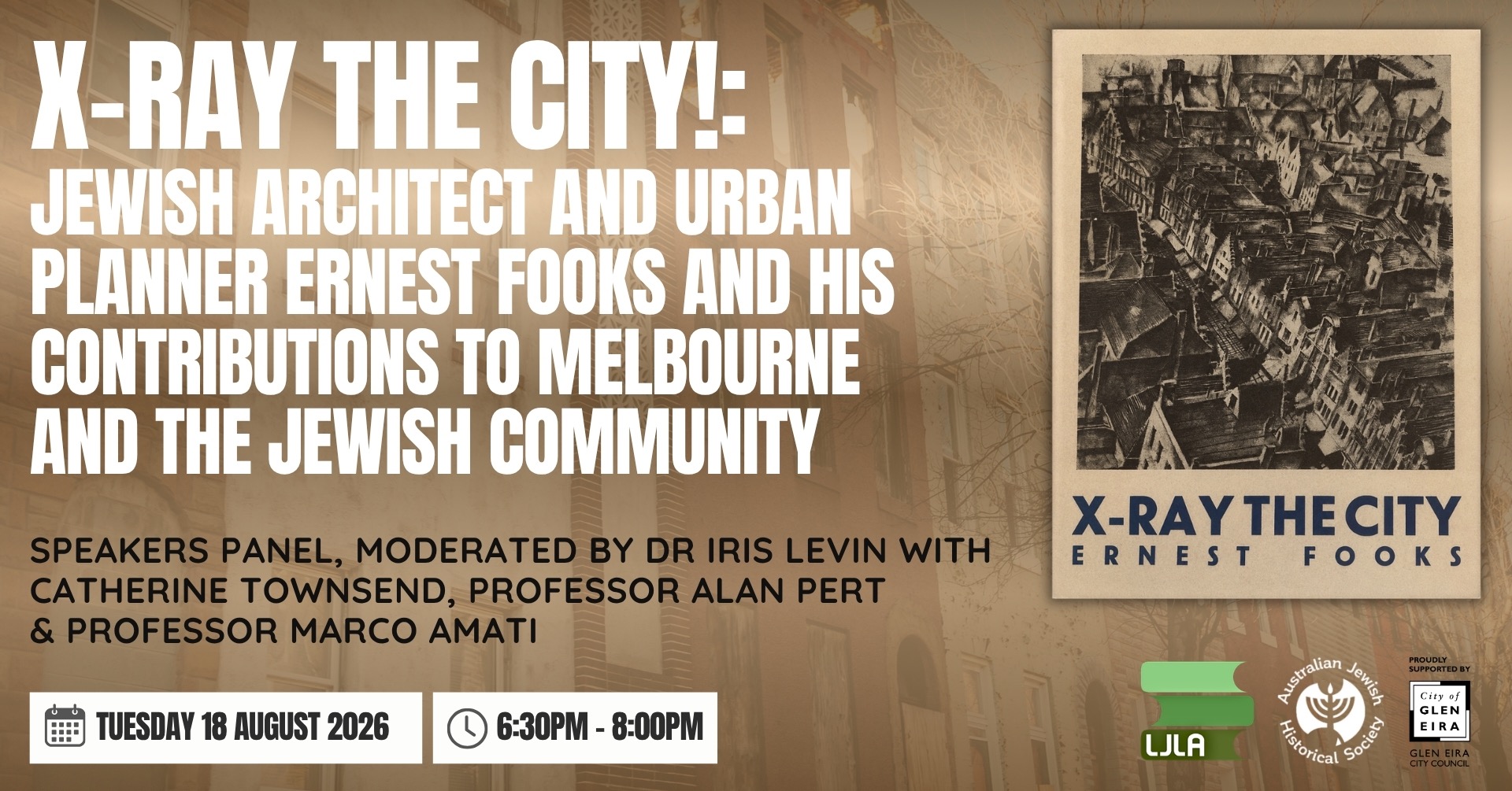
X-Ray the City!: Jewish architect and urban planner Ernest Fooks and his contributions to Melbourne and the Jewish community
A celebration for the 80th anniversary of the book X-Ray the City! with a panel of architects and planners
- Catherine Townsend, architectural historian, PhD candidate, Architecture, Building and Planning, The University of Melbourne
- Professor Alan Pert, Interim Dean, Architecture, Building and Planning, The University of Melbourne
- Professor Marco Amati, Professor of Planning, GUSS, RMIT University
Directing the panel: Dr Iris Levin, Senior Lecturer, GUSS, RMIT University
X-Ray the City! (1946) is Ernest Fooks’ sharp critique of modern urban life and the hidden forces shaping cities. Written in the aftermath of war and rapid industrial change, the book “x-rays” the city to reveal how poor planning, overcrowding, traffic, pollution, and speculative development damage health and everyday living. Fooks argues cities should be designed scientifically and humanely, prioritising sunlight, fresh air, green space, efficient transport, and well-planned housing. Its importance lies in linking architecture, public health, and planning into one agenda, pushing Australian audiences to treat urban design as a social responsibility—not just a technical or commercial task.
In 2026, X-Ray the City! Celebrates its 80th birthday and is still relevant to Melbourne and Australian planning and development.
Ernest Fooks (1906–1985) was an Austrian-born Jewish architect who became a significant figure in Australia’s post-war modern movement. Trained in Europe and shaped by the social and political upheavals of the 1930s, Fooks migrated to Australia after the Second World War and established his practice in Melbourne. He is best known for designing carefully planned, human-scaled modernist houses and medium-density housing that responded to climate, light, and everyday family life. Fooks promoted functional planning, economical construction, and a restrained architectural language influenced by European modernism, while adapting these ideas to Australian suburban conditions. Alongside his architectural work, he was an active writer and advocate for better housing standards, contributing to broader debates about urban planning, design quality, and liveability. Today, his projects are valued for their clarity, disciplined detailing, and lasting contribution to Melbourne’s modern architectural identity.
Did you live in one of the houses or buildings that Fooks planned?
Do you know anyone who did?
Do you have any memories or thoughts about the public building he planned?
Please share your memories and thoughts with us on the evening or contact the library beforehand on library@ljla.org.au

Contact Form

Resend recently purchased tickets to our events to your email.
Enter email to start search
You can review the event organiser's terms and conditions here.