Building an event community
Running a successful single event is one thing. Building a community of attendees who keep coming back, bring their friends, and genuinely care about what you’re doing is something else entirely – and it’s where the real long-term value for your organisation lies. This guide covers the practical strategies that turn a one-off crowd into a loyal, engaged community.
What makes a great attendee experience?
Community starts before the event begins and doesn’t end when the lights go up. The foundation of everything that follows is an event experience that people genuinely want to return to.
Welcoming arrival – the way attendees are greeted at the door sets the tone for everything that follows. A clear registration process, a friendly face at the entrance, and basic wayfinding (where are the bathrooms? where should I sit?) all communicate that you’ve thought about your attendees and their comfort. These things cost nothing but attention.
Customer service throughout – if something goes wrong, how you respond matters more than the problem itself. An apology and an immediate alternative is far better than a shrug. Being approachable and responsive at the event itself – not just at the front desk – is what makes attendees feel genuinely looked after.
Post-event follow-up – don’t go quiet the moment the event ends. A thank-you email with a photo gallery, a link to a recording, or simply a message acknowledging that your attendees showed up goes a long way. It’s the most underused moment in event community building.
How do I help attendees connect with each other?
The most powerful community-building happens between attendees, not just between attendees and you. If people leave your event having made a connection – met someone interesting, had a conversation they’ll remember – that’s what brings them back.
Structured networking – introductory activities, table discussions, or facilitated networking sessions lower the barrier for people who might otherwise spend the evening talking only to the people they arrived with. These don’t need to be elaborate; even a well-framed question posed to the room at the start of the evening can shift the energy.
Event-specific hashtags – give attendees a way to connect digitally during and after the event. A shared hashtag encourages people to post, creates a feed that captures the energy of the event, and extends your reach beyond the room.
On-the-day competitions or participation – a trivia round, a prize draw, a crowd vote, or a live poll gives attendees a collective experience and something to talk about. It shifts the event from something people watch to something they’re part of.
How do I keep attendees coming back?
Loyalty doesn’t build itself. You need to give people a concrete reason to prioritise your next event over everything else competing for their time and attention.
Recognition – people respond to being remembered. Shout-outs to regular attendees, personalised thank-you messages, or even a simple “good to see you again” from an organiser who recognises a familiar face signals that loyalty is noticed. You don’t need a formal programme for this – just genuine attentiveness.
Incentives that add value – preferred seating, early access to tickets, a small gift, or an exclusive opportunity to participate (a Q&A session, a workshop, backstage access) are all examples of incentives that reward loyalty without resorting to discounts. Discounting your ticket price can devalue your event in the eyes of regular attendees; adding value doesn’t carry the same risk.
Consistency and evolution – regular attendees want to know roughly what to expect from your event, and they also want each one to offer something new. The balance between consistency (same format, same quality, same feel) and freshness (new content, new faces, new experiences) is what keeps a community engaged over time. After each event, ask: what worked, and what should we change next time?
Should I charge for my event or make it free?
There’s a counterintuitive dynamic with free events that’s worth understanding. Research consistently shows that free events have higher drop-out rates than paid ones – sometimes as high as 40% – because people don’t feel the same degree of commitment when there’s nothing at stake. When your event is free, even a small charge or a requested donation can meaningfully reduce no-shows and increase the energy in the room.
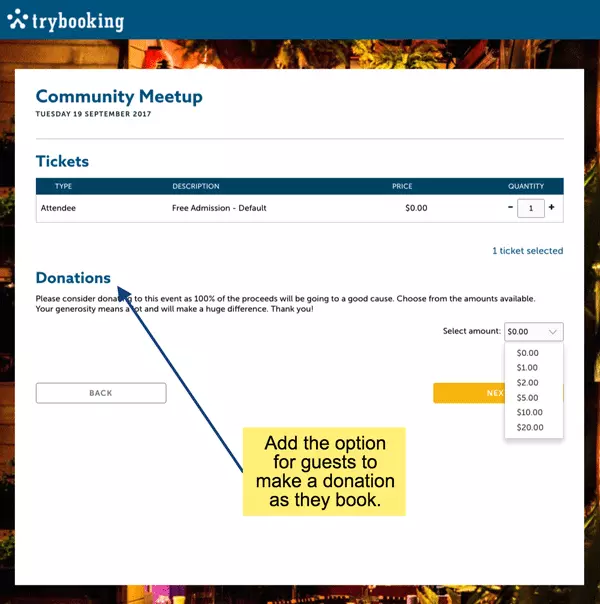
If you want to keep your event free but improve attendance rates, consider using a hand-back feature that allows registered attendees to return their tickets if they can’t make it. This frees up spots for people on a waiting list and signals to attendees that their spot has real value. If you’d like to offer a donation option at the time of booking – allowing attendees to contribute what they feel the event is worth – that’s a low-friction way to add some skin in the game without excluding anyone.
How do I use attendee data to build community?
Knowing who your attendees are – where they came from, how often they attend, what they engage with – is essential for building a community that feels personalised rather than broadcast.
Useful questions to capture at registration:
- Is this your first time attending one of our events?
- How did you hear about this event?
- What brought you here today?
The answers let you segment your communications. New attendees get a different welcome than regulars. People who came via a community partner get a different follow-up than people who found you via social media. Personalised messaging – even light personalisation – converts at a much higher rate than generic blasts.
Use your post-event data to identify your most loyal attendees. These are your community core – the people worth recognising, thanking, and involving more deeply in what you do.
How do I partner with other organisations to grow my community?
Your community grows faster when you partner with organisations that share your audience. A joint event, a co-promoted activity, or even a cross-referral arrangement with a complementary organisation exposes your work to people who are already inclined to engage.
Choose partners whose values and audiences align with yours. A poorly matched co-branding arrangement can confuse your community rather than grow it. A well-matched one puts you in front of exactly the right people with a warm introduction from a source they already trust.
How do I keep my events fresh for regular attendees?
Long-term community retention requires that events evolve. The fastest way to lose regular attendees is to run the same event on repeat without change. Gather feedback – a short survey after each event, informal conversations on the night, a question asked directly of your most engaged attendees – and act on what you hear.
Attendees who feel their input shapes the programme feel invested in its success. That investment is the foundation of genuine community.
How can TryBooking help me build an event community?
TryBooking’s data collection tools let you ask custom questions at the point of booking, so you can capture the information that helps you understand and segment your audience. You can also use TryBooking’s reporting to identify repeat ticket buyers – attendees who’ve been to multiple events – so you can acknowledge and reward your most loyal community members.